
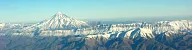
Mountains in Iran cover 50% of the country's territory and determine its natural and climatic characteristics.
The longest mountain range is the Zagros Mountains. This chain of mountains stretches for 1,500 km from the border with Turkey to the Strait of Hormuz. It is home to more than 100 peaks over 3,000 m. The highest point of the Zagros Mountains is Mount Zardeh (4,548 m). The Zagros ranges form natural boundaries between climatic zones: the western slopes receive more precipitation, while the eastern slopes are drier.
In the north of the country, the mountains of Iran are represented by the Alborz Range, which runs along the Caspian Sea. Its main peak, Mount Damavand (5,610 m), is not only the highest point in Iran but also the highest volcano in Asia. Damavand is clearly visible from Tehran and is a popular destination for climbers. Mount Elborz traps moist air masses, giving the Caspian Sea region a mild, humid climate.
In eastern Iran, mountains form the East Iranian Plateau, including the Birjand, Kerman, and other ranges. These ranges are lower in elevation than the Zagros and Elborz mountains (averaging 2,000–2,500 m), but play a key role in the formation of river systems that feed the oases.
The mountains of Iran are rich in minerals: copper, iron, polymetals, and turquoise are mined here. Furthermore, the mountainous regions are home to rare species, including the Persian leopard and ibex. For locals, Iran's mountains provide water, pastures, and traditional livelihoods, while tourists enjoy trekking, rock climbing, and exploring unique mountain villages.

Dizin Ski Resort
Discover Dizin Ski Resort, Iran's largest and highest-altitude ski destination with FIS-certified trails, 950m vertical drop, long season until May, and excellent powder snow.

Iran Ski Resorts
Dizin, Shemshak, Tochal, Pooladkaf, Tarik Darreh, Darbandsar, Sahand, and Alvares — trail characteristics, lifts, infrastructure, hotels, and entertainment options.


- GUIDED GROUP TOUR

Guided group tour package
Tehran - Shiraz - Persepolis - Yazd - Isfahan - Abyaneh - Kashan
Tour start dates:
26.02.2026 - 04.03.2026
08.03.2026 - 15.03.2026
05.04.2026 - 12.04.2026
19.04.2026 - 26.04.2026
03.05.2026 - 10.05.2026
17.05.2026 - 24.05.2026
SGL € 750 per person
DBL € 650 per person
- GUIDED GROUP TOUR

Guided group tour pacakge
Tehran - Shiraz - Persepolis - Yazd - Isfahan - Abyaneh - Kashan - Qeshm Island - Hormuz Island - Hengam Island - Tehran
Tour start dates:
26.02.2026 - 07.03.2026
08.03.2026 - 19.03.2026
05.04.2026 - 16.04.2026
19.04.2026 - 30.04.2026
03.05.2026 - 14.05.2026
17.05.2026 - 28.05.2026
SNG € 1 200 per person
DBL € 1 000 per person