
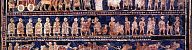
The Art of the Ancient Near East: Study Approaches and Typology
Describing the development of artistic culture in ancient Near Eastern civilizations as a unified process is possible only with significant caveats. Historical trajectories of these societies reveal the instability even of geographical fragmentation. Initially, several civilizations developed in isolation; later, they expanded their borders; subsequently, they established contacts with one another; and ultimately, they merged.
Moreover, factors of social, ethnic, political, and ideological (including religious) fragmentation proved even more variable over time. To develop a comprehensive understanding of similarities and differences in cultural processes across various stages and societies, it is essential to correlate transformations in artistic culture with the specific historical trajectories of ancient Near Eastern civilizations.
It is also crucial to recognize that, to date, only visual art provides us with sufficiently complete typological series of artefacts. These can be meaningfully compared both temporally and spatially—primarily in historical rather than strictly geographical terms.
The Art of the Ancient Near East: Continuity and Break with Prehistoric Art
The question of continuity between the artistic culture of ancient Near Eastern civilizations and prehistoric art remains complex and insufficiently explored. The challenge arises when we move beyond speculative theoretical frameworks—such as the abstract notion of tradition transmission across societal transformations—and attempt to identify the specific artistic "heritage" that various peoples (each with their own unique legacy) brought to the creation of early agricultural irrigation civilizations.
It is safe to assert that no direct and unbroken line of inheritance exists to connect:
- the pinnacles of Paleolithic art;
- the finest achievements of Neolithic artistic culture;
- semi‑pastoral tribes forced to settle on lands least suitable for agriculture in their time.
Current archaeological evidence allows only for a general reconstruction of the level of artistic consciousness among the creators of ancient artefacts.
Ubaid Period Cult Figurines: Symbolism and Meaning
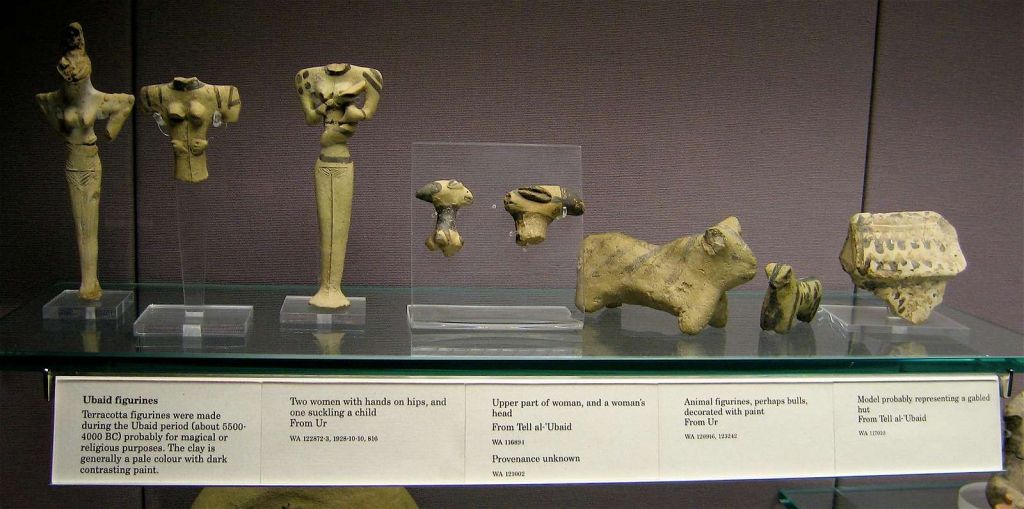
Consider the cult figurines from the Ubaid period (mid‑4th millennium BCE), which immediately preceded the emergence of ancient Mesopotamian civilization, as well as slightly later Elamite examples. These likely carried symbolic meaning (i.e., they expressed something) exclusively for their creators—unless, of course, they formed part of a specific ritual performance or were accompanied by a fixed prayer (about which we have no knowledge).
The symbolic value in these artefacts often surpassed their physical form:
- grains of cereal or date pits used to represent eyes on faces (neither human nor animal) held greater significance than the figurines themselves when prayers for a good harvest were offered;
- emphasized sexual characteristics on female figurines (sometimes faceless and armless) did not depict a fertility goddess but rather served as a materialized prayer for offspring.
Ritual Nature of Worldview
Even after the construction of the first irrigation canals and the transformation of communities into cities, human worldview remained immersed in the realm of collective ritual or magical performance, including:
- choral recitation of myths;
- magical dances;
- utterance of incantations.
Unity of Form and Content in Prehistoric Art
A profound interconnection emerges here: just as the rhythm of alternating animals, shoots, geometric shapes, and other elements in the ornamentation of a Neolithic vessel is inseparable from the rhythm of the potter’s wheel (and possibly from the song accompanying this process), so too is the ornament itself inseparable from the vessel and its functional purpose.
In prehistoric art, everything depicted—including the human figure—remains an integral part of the surrounding world and nature.
Art of the Ancient Near East: The Dawn of Civilization
1. The Emergence of Temple Architecture
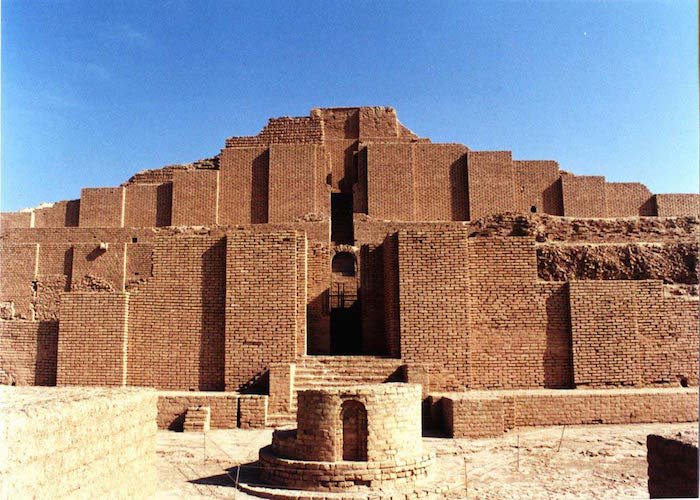
The first step toward the separation of artistic consciousness in early civilization was the construction of a temple — the «house of god» that embodied the idea of the community’s chief deity.
Key features of temple architecture development:
- Initial stage: an altar or sacred stone in the open air;
- Evolution: building a structure on a hill or artificial platform with a statue/image of the deity;
- Rapid stabilization: forms remained virtually unchanged for millennia [G. Flittner, 1958; André, 1930; Parrot, 1946].
Examples of architectural monuments:
- The «Temple of Obelisks» in Byblos (2nd millennium BCE) — early stage of development;
- Ziggurat of the III Dynasty in Ur (late 3rd millennium BCE);
- Ziggurat at Choga Zanbil in Elam (mid-2nd millennium BCE).
2. The Birth of Writing and the Development of Visual Language
The second major step was the emergence of an information transmission system that preserved content accuracy:
- Need to record economic data (livestock, grain, oil);
- Creation of a personal seal-amulet as a property marker linking a person to their patron deity.
Development of pictographic and hieroglyphic writing:
- Selection of a defined set of drawings and symbols from general imagery;
- Stable connection between image and concept (unlike primitive art);
- Progressive association of symbol: with concept → with word → with phonetic value [Falkenstein, 1936; Schmandt-Besserat, 1977].
Early stage characteristics:
- Visual narration of events (victory over enemies, sacrifices);
- Inscriptions for non-visualizable elements (names of kings, priests, gods);
- Formation of visual language with primitive morphology and syntax;
- Selection of subjects for depiction and introduction of restrictions/prohibitions;
- Emergence of specialized image-makers (possibly combined with scribal duties).
3. Main Thematic Directions in Ancient Near Eastern Visual ArtsConclusion: The emergence of pictographic writing is a typological marker of early civilizations’ art formation.
From the beginning, two principal themes emerged:
- Religious (beliefs, magic, religious concepts);
- Secular (earthly events, rulers’ deeds).
Regional specifics:
- Sumer (early period): predominance of religious themes (known from stamp and cylinder seal images);
- Egypt: focus on pharaohs’ deeds and funerary cult subjects [Matheu, 1968].
4. Development of Religious Imagery in Mesopotamia
A pivotal moment was the unification of Mesopotamia under the Sargonids, when:
- Cylinder seals began to feature identifiable deities with personal attributes, emblems, and symbols;
- Symbols gradually became more specialized (especially during the Kassite period);
- Traditional figures (supernatural heroes, «masters of beasts») transformed into «secondary deities» (guardians of main deities);
- Increased narrative variety in cylinder seals.
5. Monumental Art in Mesopotamia: The Theme of King’s DeificationDebated hypothesis: cylinder seals may have replicated lost monumental temple compositions (e.g., wall paintings).
Monumental art (reliefs, stone statues) centered on the theme of ruler’s deification.
Evolution of temple sculpture:
- Pre-Sargonid period: deity figurines (30–40 cm) with distorted proportions and emphasized details (large ears as wisdom symbols, disproportionately large eyes);
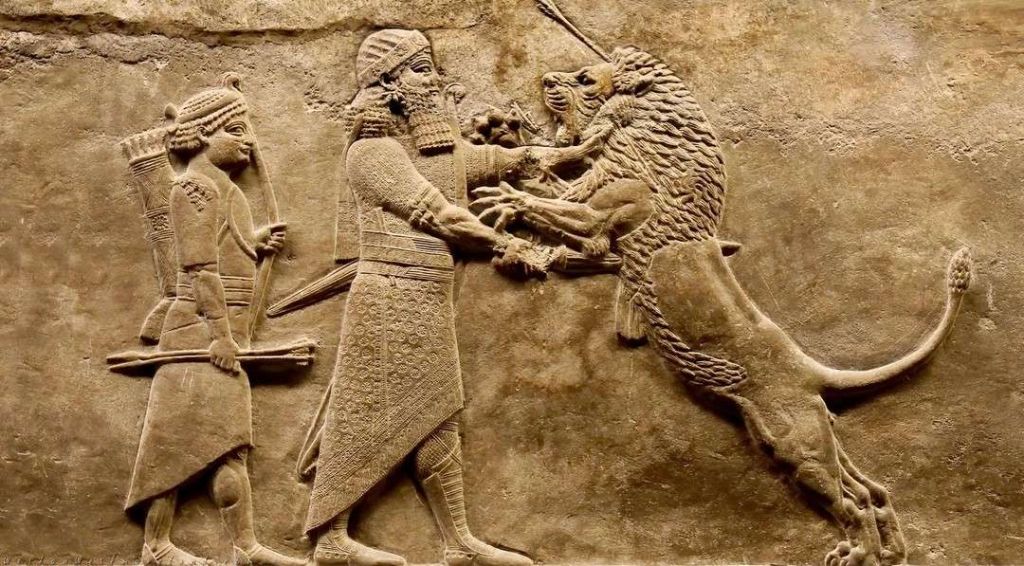
- Under the Sargonids: statues of specific rulers, compositions depicting the hero-king’s combat with a lion, victorious campaigns [Afanasyeva, Dyakonov, 1961].
6. Transformation of Iconographic Images
Two key themes (religious and royal) dominated ancient Near Eastern art from the mid-3rd millennium BCE. Meanwhile, religious imagery, close to symbolic representation, remained stable and could be radically reinterpreted with political or ideological changes:
- Scorpion-man in Sumer (3rd millennium BCE): guardian of the solar god’s path → in 2nd millennium BCE: one of the evil genies — companions of Tiamat;
- Human-bull (4th millennium BCE): associated with cosmic elements → guardian of the solar deity (Akkadian and Assyrian) → in Iranian iconography (from 6th century BCE): symbol of the «primordial bull» Gopatshah.
Such examples of reinterpretation of ancient visual arsenal (4th–3rd millennia BCE) are numerous among peoples inheriting Mesopotamian culture.
7. Art of the «Great Empires» Period (2nd–1st millennia BCE)
During this period, the iconographic heritage of previous eras was actively employed for royal themes. Assyrian art is particularly illustrative, featuring:
- Participation of craftsmen from various regions (Mesopotamia, Asia Minor, Syria, Phoenicia, Egypt);
- Stone reliefs (primary art form) borrowed from the Hittites, but executed on thinner slabs.
Central theme: the greatness of the deified king («king of the universe»).
Typical subjects:
- Battle scenes;
- Hunting and feasting scenes (traditional for both Near East and Egypt).
Characteristics of Assyrian reliefs:
- Visual records of kings’ victorious annals;
- Strict rules for king’s depiction (idealized image of the ruler);
- Division of relief into horizontal bands to organize crowded scenes;
- Combination of different viewpoints («top view» and «side view»);
- Meticulous detailing of objects (furniture, armament, harness, jewelry, clothing, valuables).
Significance: Assyrian reliefs represent a rare example of synthesis between Egyptian civilization’s skills and Mesopotamian traditions through the lens of Asia Minor art [Parrot, 1961].
An even more complex synthesis is demonstrated by Achaemenid «imperial» art (especially the sculptural decoration of Persepolis), involving craftsmen from Greek cities of Asia Minor [Ghirshman, 1963].
This art represents a unique fusion of diverse cultural traditions:
- Mesopotamian iconographic motifs and narrative schemes;
- Egyptian stylistic elements and symbolic language;
- Anatolian architectural solutions and decorative techniques;
- Greek artistic innovations in proportion, anatomy, and spatial organization.
The sculptural program of Persepolis reflects the ideological goals of the Achaemenid Empire:
- Visual assertion of imperial unity through depiction of subject nations and their tribute bearers;
- Glorification of the king as a universal ruler and mediator between heaven and earth;
- Creation of a standardized visual language that could be understood across the vast empire.
Key formal characteristics of Achaemenid imperial art include:
- Strict adherence to hierarchical scale and compositional order;
- Refined treatment of drapery and anatomical details (particularly in figures of Greek workmanship);
- Balanced combination of relief levels to create spatial depth without full three-dimensionality;
- Repetition of standardized motifs (such as the «king and attendants» or «procession of nations» scenes) across different monuments.
Significance: The Achaemenid artistic synthesis not only reflected the empire’s political ambitions but also created a lasting visual legacy that influenced subsequent art traditions in the Near East and beyond.
Conclusion
The art of the Ancient Near East evolved through distinct phases — from early temple architecture and proto-writing systems to the sophisticated imperial styles of Assyria and Achaemenid Persia. Each stage reflects:
- The interplay between religious and royal themes;
- The adaptation and transformation of inherited iconographic traditions;
- The role of art as a tool for political and ideological expression.
This rich artistic heritage laid the groundwork for later developments in Mediterranean and Near Eastern art, demonstrating the enduring power of visual communication in human civilization.
Art of the Ancient Near East: Stages of Visual Development in Mesopotamia
The development of visual art in Mesopotamia (considering the general pattern, not individual deviations) unfolded in three major stages.
Mid‑4th — Mid‑3rd Millennium BCE
In Lower Mesopotamia, the following gradually emerged:
- anthropomorphic representations of deities;
- their symbols and signs (initially local, "readable" within one or several communities).
Key characteristics of this period:
- religious consciousness reflected only oral myths and ritual texts;
- symbolism had not yet developed into a universally accessible system;
- images were either magical (closed, narrowly understood) or served as "records" of annals — narratives about major events (campaigns, victories).
Notable artworks:
- The Stele of the Hunt from Uruk (early 3rd millennium BCE) — depicts the king's combat with a predator;
- Cult vessel from the Jemdet Nasr period (from the temple of goddess Inanna in Uruk) — the image is "read" in registers (bottom to top):
- procession of domestic animals belonging to the temple;
- row of identical male figures bringing offerings to the temple;
- altar with offerings marked by the goddess's symbol, accompanied by a priestess representing Inanna [Afanasyeva, 1976].
Mid‑3rd — Late 2nd Millennium BCE
Defining features of this stage:
- creation of deity images with stable symbols and clear iconographic distinctions;
- systematization (following a hierarchical scheme) of previously developed cult imagery;
- fixation of symbolism and iconography for deities with specific functions (regardless of their names in different communities and cities);
- specialized interpretation facilitating character identification.
Development of monumental art:
- statues;
- large reliefs;
- steles;
- later — wall paintings, etc.
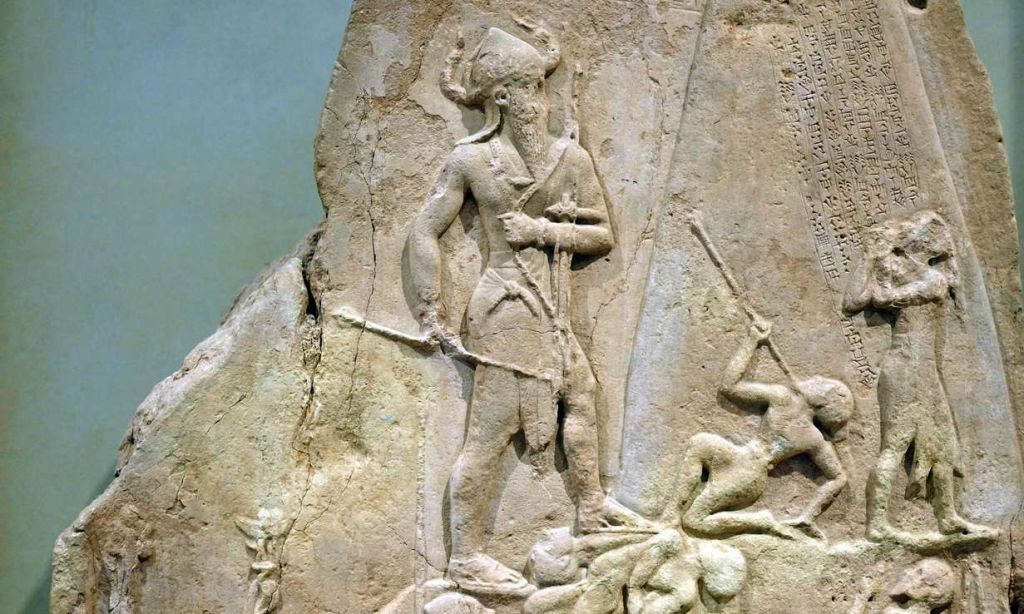
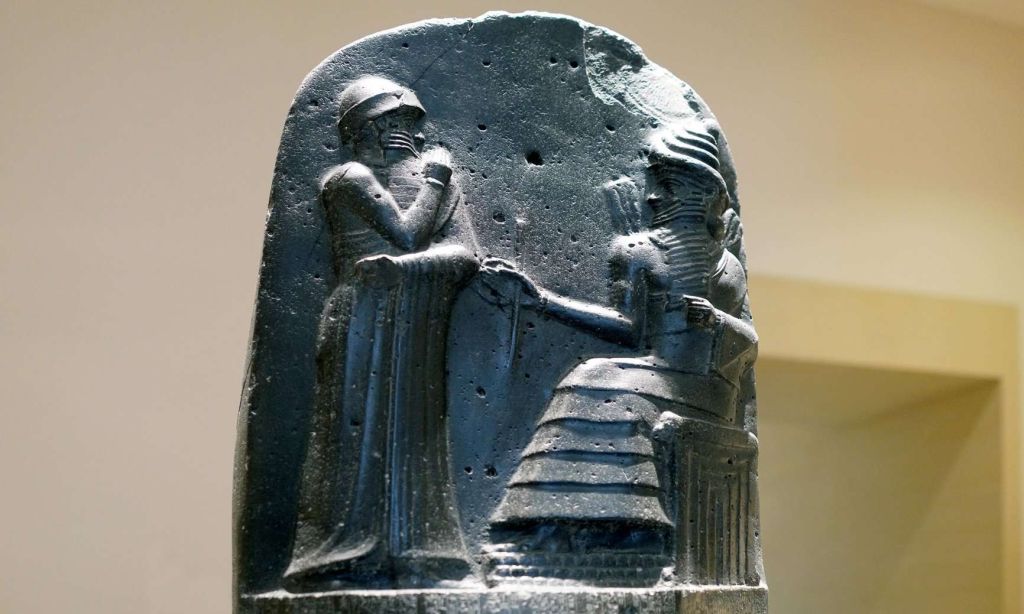
Canon formation (particularly in the theme of the ruler's exploits), based on a clear ideological framework:
- emphasis on "significant features" unrelated to individuality;
- use of strictly defined "investiture signs" of the ruler;
- regulation of the ruler's position in composition, gestures, and poses.
Dominance of narrative — depiction of "text" through sequential episodes ("frames"), particularly in the theme of the ruler's exploits.
2nd — 1st Millennium BCE
Key features of this stage:
- the established "image bank" became a universal resource for all religions, ethnic groups, and ideological demands of rulers;
- minimal addition of new elements (Hurrians, Kassites, Amorites, Hittites, Iranians, etc. contributed little);
- adaptation to new characters through reinterpretation of existing images.
Outcomes of this process:
- formation of visual language for the "great empires" of the Near East;
- creation of artworks by nomadic groups invading the Near East (e.g., elements of early Scythian art).
Nature of canons:
- modification of specific features while preserving essence;
- development of two interconnected themes;
- use of the same "characters" with similar distinctive features ("signs").
Characteristics of the eclectic nature of Near Eastern art:
- possibility to identify borrowings from various peoples and styles of different schools (masters);
- preservation of fundamental ideas while changes mainly affect the "syntax" rather than the content of the "text".
Art of the Ancient Near East: Ancient Egyptian Art
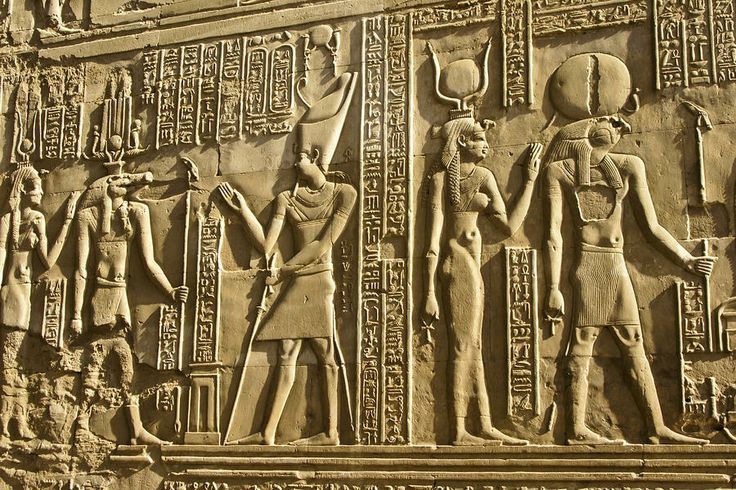
In ancient Egypt, the foundations of monumental architecture, monumental sculpture, reliefs, mosaics, wall paintings, and other art forms emerged at the very dawn of civilization. Similar to Mesopotamia, two principal themes developed here — religious imagery and the theme of the ruler’s exploits. However, due to the specific nature of ancient Egyptian religion, these themes were intertwined much more closely.
1. Canon and Ritual Requirements
Key characteristics of Egyptian visual art:
- early establishment of strict order and hierarchy (compared to the art of the Near East);
- less eclecticism at both typological and stylistic levels;
- proximity to the model of “ideally traditional” art.
The canon was fundamentally shaped by the requirements of funerary rituals. Attempts to weaken the canon — such as during the Amarna period — were perceived as:
- deviations from prescribed rituals;
- challenges to the ideological foundations of civilization;
- spiritual rebellion, which was not tolerated even for the pharaoh (the supreme ruler and deity).
2. Ritual as a Regulator of Artistic Practice
The ritual dictated not only the content of visual monuments but also the precise methods of its expression — down to the smallest details.
Although specialized treatises with instructions (such as the manuscript “Prescriptions for Wall Painting and the Canon of Proportions” kept in the temple library of Edfu in the 3rd–2nd centuries BCE) have not survived, their content can be reconstructed from instructions in ritual texts — primarily the “Book of the Dead”. These prescriptions remained unchanged for millennia.
Evidence of strict adherence to canons persists even into the Hellenistic period. For example, in the secret chapel of the temple at Dendera, inscriptions were found:
“Sacred statues of the goddess are carved according to correct proportions, in accordance with ancient books; the height of the images follows the ‘Souls of Ra’ (i.e., sacred writings).”
“Birds are painted according to prescription, in accordance with the ‘Souls of Ra’.”
3. “Realism” and “Portraiture” in Egyptian Art
Canonical norms determined:
- “Realism”: inclusion of identifying marks of social status, accurate anatomical rendering, especially emphasized musculature in depictions of the pharaoh;
- “Portraiture” of statues: applied only to specific images — so that the eternal soul state (“ka”) could recognize its owner;
- “Official” statues: their primary purpose was to express the social status of the depicted figure;
- Relief images: intended for tombs and temples.
Despite the expanding circle of individuals placing statues in temples and fluctuations in expenditure on funerary structures, all ritual prescriptions were strictly observed — as they had been established at the beginning of the 3rd millennium BCE [Diakonov et al., 1982, vol. 1, pp. 263–274].
4. Artistic Centers of Ancient Egypt
Even within the strict framework of the canon, a dynamic is observable: at different stages of history, some artistic centers rose while others declined.
Leading artistic centers typically coincided with political capitals:
- 3rd millennium BCE (Dynasties III–VIII) — Memphis;
- 16th–12th centuries BCE (Dynasties XVIII–XX) — Thebes;
- from mid-7th century BCE — Sais [Landa, Lapis, 1977].
Sometimes these cities retained artistic significance even after the political capital was moved elsewhere.
Notable phenomena:
- Flourishing of provincial schools: observed during periods of weakened central authority (23rd–21st centuries BCE; 21st–17th centuries BCE), when each school developed its own “individuality”;
- Rise of Abydos: at the end of the Old Kingdom period, the city became a major religious center associated with the cult of Osiris (the king of the dead). The workshops of Abydos, receiving commissions from various cities, evolved into a pan-Egyptian artistic center that maintained its authority into the 1st millennium BCE.
Art of the Ancient Near East: The Art of Ancient Eastern Empires
If the art of ancient Egypt represents an early stage of ancient Eastern artistic culture that remained largely unchanged for millennia, and if the art of Mesopotamia during its peak periods reflects the next stage of visual development, then the art of the ancient Near Eastern «great empires» (late 2nd — 1st millennium BCE) should be seen as the final stage of this process. In this phase, eclecticism — already present in the second stage — reaches its maximum expression.
1. The Nature of Imperial Art
In the sphere of artistic culture, the rulers of these «world states» pursued policies parallel to their economic strategies:
- As territories were conquered, diverse ideas, styles, and genres were absorbed into the imperial «melting pot».
- Mass deportations brought craftsmen from across the known world to the imperial centers (capital cities, royal courts, and major cultural hubs), wh ere they formed vast «guilds».
- Monarchs looted conquered cities and treasuries, transporting artworks (relics and treasures) to fill their palaces, temples, and storehouses — though these were valued not for their original cultural significance but as symbols of conquest.
Just as territorial expansion, labor exploitation, control of trade routes, and direct plundering of cities and temples ensured economic prosperity (making warfare the most profitable «productive activity» [Diakonov et al., 1982, vol. II, pp. 15–18]), so too did imperial art serve a propagandistic function. By synthesizing foreign (and sometimes polar opposite) ideas and styles into a single, openly eclectic whole, it asserted the very idea of dominion over conquered peoples. Its inseparable corollary was the declaration of unity among diverse peoples under the great king — a unity that, though often illusory, could endure for centuries.
2. Art of the «Great Empires»: Hittite, Assyrian, and Achaemenid
The art of the «great empires» — less so of the Hittites, far more so of the Assyrians and Achaemenids — while unquestionably distinctive and recognizable as a whole, can easily be broken down into numerous foreign elements upon closer examination.
For example:
- The palace of Achaemenid King Darius at Susa (Elam) was built and decorated by Lydian, Ionian, Babylonian, Egyptian, Median, Bactrian, and other craftsmen [Girshman, 1963; Nilander, 1970; Porada, 1965; Lukonin, 1977; Dandamaev & Lukonin, 1980, pp. 255–258].
- The decoration of Assyrian King Sargon II’s palace at Dur-Sharrukin was created by Phoenicians, Babylonians, Egyptians, and Hittites [Parrot, 1961; Afanasyeva, 1968, pp. 41–54].
3. Material Legacy and Iconography
Thanks to the Near Eastern rulers’ preference for durable materials (particularly stone), the visual culture of this era is exceptionally well-preserved. It includes:
- Architecture of palaces, temples, and cities (e.g., Hittite Carchemish; Assyrian Ashur, Nineveh, Kalhu; Urartian Karmir Blur; Achaemenid Persepolis and Susa).
- Kilometers of stone orthostats and reliefs.
- Tens of square meters of wall paintings and glazed brick panels.
- Thousands of figures depicting warriors, slaves, captives, etc.
One relief fr om the reign of Assyrian King Sennacherib (705–680 BCE), depicting the transport of a stone statue, covers 15 square meters and includes over 120 figures. The repertoire of subjects is vast: city sieges, ceremonial receptions, hunts, feasts, military encampments, construction scenes, etc. — all glorifying the great king with monumental force, sometimes overwhelming the common subject with their fantastical power.
Examples include:
- Colossal human-bull figures (Assyrian shedu at Dur-Sharrukin; Achaemenid gopatshahs at Persepolis, over 4 m tall).
- Royal statues exceeding normal human height by more than twice (e.g., Ashurnasirpal II; Darius, one of which was carved by an Egyptian sculptor and bears inscriptions in Egyptian, Elamite, Akkadian, and Achaemenid cuneiform).
4. Case Study: Hittite Art
The Hittite state provides a typical model for this stage of ancient Near Eastern art. The Hittites (Nesites), an Indo-European people, conquered central Anatolia in the 18th century BCE, absorbing the earlier Hattic and Hurrian city-states — which had not yet developed stable political unification by the late 2nd millennium BCE.
Key features:
- Hattic and Hurrian religious imagery lacked a fully developed «sign system» and symbolic vocabulary due to Anatolia’s peripheral status in the 3rd–2nd millennia BCE.
- Hittite tribes were at a similar or earlier stage of development.
- The fusion of Hattic-Hurrian and Hittite cultures produced the Old Hittite kingdom (1650–1500 BCE).
Religious iconography:
- Chief deity: Storm God («King of Heaven, Lord of the Land of Hatti»), symbolized (not consistently) by an axe.
- Sun Goddess: lacked developed iconography.
- Sacred stones: individually standing or sculpted; the sky itself was conceived as stone.
- «Thousand Gods of Hatti»: a long procession at Yazılıkaya, iconographically indistinguishable from the portrait of King Muwatalli at the Pyramus River in Cilicia.
Only after contact (and later conquest) of northern Mesopotamian regions during the Neo-Hittite kingdom (1400–1200 BCE) did the Hittites adopt a broader «bank of images» — including divine attendants, fantastic creatures, and divine symbols — yet they never developed a clear symbolic hierarchy in their iconography.
5. Architectural Achievements: Bit-Hilani
The bit-hilani (a rectangular building divided into unequal longitudinal sections, with an entrance porch flanked by rectangular towers) served primarily as a temple (though also as palaces and private homes). Key features:
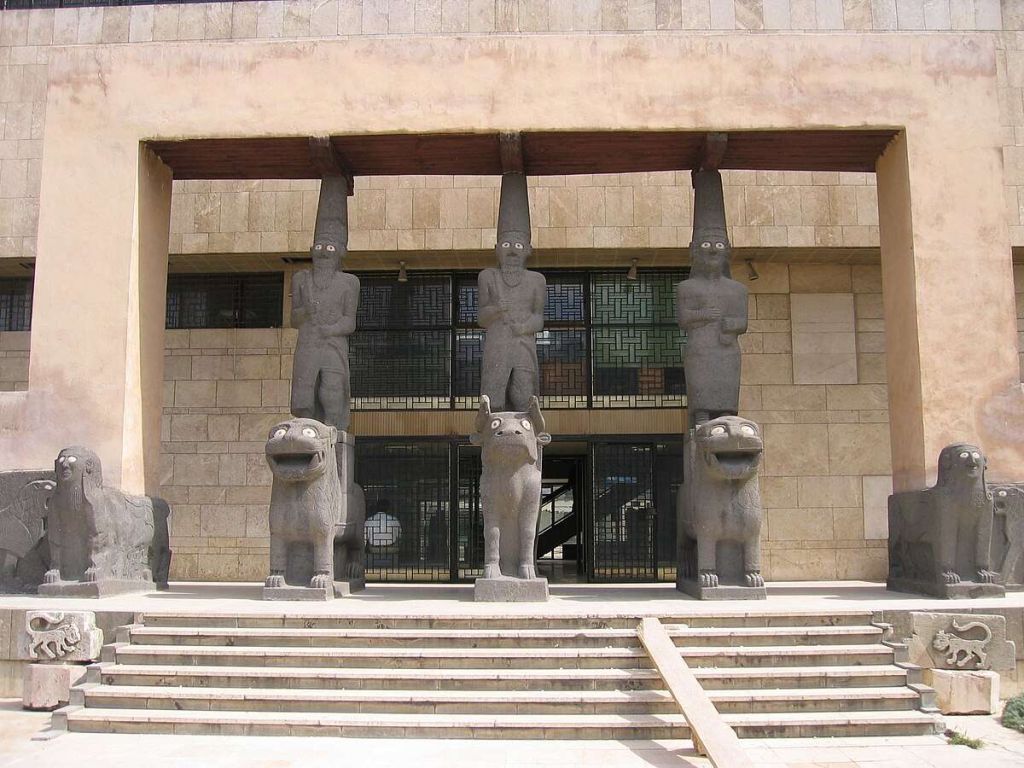
- Porch columns sculpted as deities.
- Stone orthostats depicting «Thousand Gods of Hatti», the king, animals, and birds — without clear ordering or thematic coherence [Akurgal, 1961].
At Tell Halaf (early 1st millennium BCE), identical male figures in royal attire stand on lion and bull backs — possibly representing different deities (lion = solar deity in Babylon and Assyria; bull = water deity), though this iconography was not standardized.
6. Assyrian Art (13th–7th centuries BCE)
Centered at Ashur (originally a trading outpost on the Mesopotamian‑north trade route), Assyrian power grew through control of these trade routes. Among the Near Eastern «great empires», Assyria stands out as the most predatory state, waging endless wars of conquest (by the 12th century BCE, Assyrian kings ruled over the entire Near East). It also maintained one of the harshest regimes, with a vast apparatus for suppressing opposition and a formidable army.
7. Architectural and Iconographic Legacy
Assyrian art and architecture inherited much from the Hittites:
- The bit‑hilani layout for palaces and temples.
- Extensive use of stone orthostats, which evolved into narrative sequences of stone reliefs.
However, Assyria also absorbed significant elements from the broader Near Eastern iconographic repertoire of earlier eras.
Religious architecture included:
- Temples and bit‑hilanis dedicated to deities.
- Ziggurats — e.g., three at Ashur: a double one for gods Anu and Adad, and a single one for Ashur.
Iconography featured:
- Deities borrowed from Babylonian and Elamite traditions.
- Mythological and demonological figures (e.g., the scorpion‑man known since the 3rd millennium BCE; winged, horned lions with griffin legs and scorpion tails).
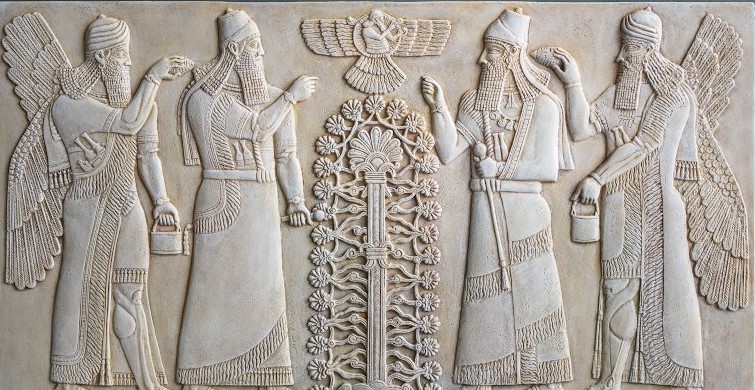
- Ancient Near Eastern guardian figures and the «sacred tree» (originally the date palm, later stylized almost beyond recognition).
Yet the supreme Assyrian god Ashur was depicted as a torso of an Assyrian king between two outstretched wings. In Assyrian visual art — particularly stone reliefs — deities and their symbols occupied secondary roles, rarely appearing alone but rather embedded within scenes glorifying the king’s heroic exploits, which dominated Assyrian art (from palace reliefs and wall paintings to bone plaques, bronze sarcophagus panels, and personal seals).
8. Secular Themes in Assyrian Art
The diversity of secular themes in Assyrian art sharply contrasts with Babylonian imagery, wh ere variations on a single theme prevail: the ruler before a deity’s statue, altar, or symbol.
Key distinctions:
- Assyria: Secular themes dominate; religious imagery (gods, demons, celestial symbols) is secondary.
- Babylonia: Endless repetition of divine and demonic figures, stars, suns, divine standards, signs, and symbols [Parrot, 1961; Afanasyeva, 1976, pp. 115–143].
Assyrian reliefs depict specific, vivid scenes:
- Royal hunts in mountains or steppes, targeting lions or gazelles.
- Feasts in palaces, gardens, or pavilions, surrounded by musicians, servants, grapevines, and singing birds.
- Violent imagery: bleeding, writhing animals (e.g., the famous wounded lioness relief fr om Ashurbanipal’s palace at Nineveh); severed enemy heads hanging from grapevines (same palace).
9. Narrative Techniques in Assyrian Reliefs
Later Assyrian reliefs feature:
- Chariot races.
- Defeated enemies.
- Sieged fortresses.
- Troop crossings.
- War trophies.
- Military encampments.
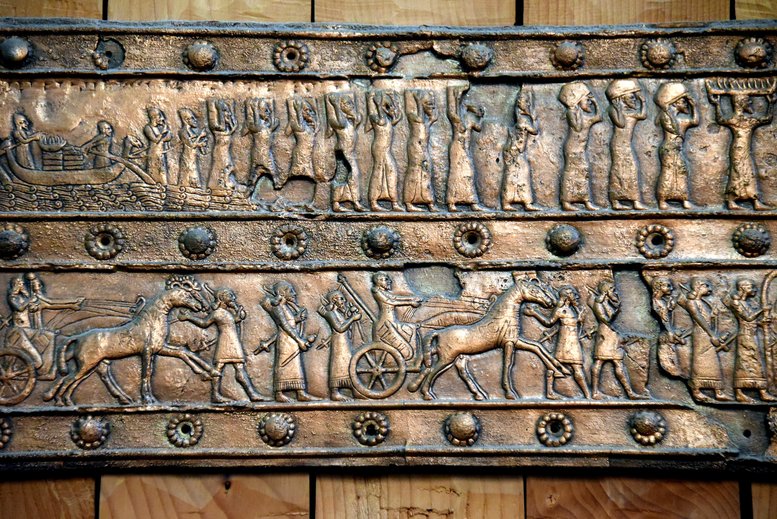
These scenes convey sequences of events: individual episodes («frames») form a continuous narrative «strip», sometimes quite long, with the passage of time indicated by the arrangement of scenes. Overall, the reliefs read like annals of Assyrian rulers [Barnett, 1959].
Examples:
- Bronze plaques of the Balawat Gates illustrate the same events described in King Shalmaneser’s inscription — the capture of Urartian city Suguniya, including looted bronze cauldrons and ritual weapons (scenes read from bottom left).
- Reliefs of Sargon II correspond precisely to the 714 BCE military campaign against Muzazir, as detailed in the king’s report to god Ashur.
10. Artistic Production and Canons
Creating these annals required an army of professionals deported from conquered lands. While we do not know the exact form of their commissions, they were likely detailed and strict in each case (despite the abundance of characters and scenes).
Strict canons governed:
- Depiction of the king.
- Placement of figures.
- Figure sizes — all subordinated to the ideological program of showcasing the king’s might and «divine» deeds.
Realistic details (weapons, jewelry, clothing) were rendered with meticulous attention to texture, yet standardized across scenes — suggesting the widespread use of templates. Templates also applied to architectural structures (e.g., all conquered cities appear identical: fortresses with high crenellated walls, platforms, towers topped with arched walkways and crenellated parapets) and animal depictions (despite varied poses, typically composed of standard parts). Landscapes («rivers», «mountains», etc.) were also introduced via templates.
Only the arrangement of images on the plane and within the confined space of a relief could not be rigidly regulated. Here, the artist retained some freedom — though often constrained by demands to include numerous figures, multiple planes (side and top views simultaneously), and to combine the beginning and outcome of an action (e.g., in hunting scenes). Successful compositional solutions were sometimes repeated, especially with recurring subjects, eventually leading to ornamentalization.
Example: A Syrian relief depicts a king on a flying horse attacked by a lion from the front; behind him, a spare horse also flying, attacked by a lion from behind. This composition is one step away from a closed, symmetrical, heraldic arrangement — whose repetition (with simplifications and loss of original content) inevitably leads to ornamentalization.
11. Contributions of Assyrian Craftsmen
Despite standardization, the contributions of Assyria’s multicultural craftsmen were immense — especially when compared to earlier stages of imperial art (e.g., Hittite «mute» art; late Babylonian priestly art’s solemn stasis).
Innovations:
- Shedu (human‑bull guardians) at Dur‑Sharrukin depicted both standing and walking: from the front, only two front legs are visible; from the side, one front leg is hidden, but a «fifth» leg appears in stride.
- First correct profile depictions (without frontal shoulder rotation) in the Near East — though reserved for secondary characters (soldiers, enemies, captives), not kings or gods.
12. Influence Beyond Assyria
While Assyrian art had little impact on Egypt or Mesopotamia, it was readily adopted in similar state formations and «young» kingdoms. For example:
- Urartu: Assyrian influence dominated, especially in court art [Piotrovsky, 1962]. However, as it merged with Urartian traditions (already rich in their own right), it evolved toward greater detail, fewer compositions, limited templates, and eventual ornamentalization (e.g., Assyrian muscles transformed into decorative swirls and, ultimately, into the «carpet style» of Urartian lions, bulls, and monsters). This marked the path of decline for Assyrian visual language — a process partly inherent to its own structure, though not all peoples under its cultural sway progressed to this final stage.

13. The Iranian Peoples: Medes, Scythians, Sakas, and Persians
Tribes that invaded the territories of Assyria, Urartu, and Elam incorporated parts of these lands into new state formations. These were nomadic Iranians — Medes, Scythians, Sakas, and Persians. The Medes and Persians gradually penetrated the Near East over centuries, coexisting with Assyrians, Hurrians, Kassites, and others. Their artistic traditions developed gradually — from imagery for tribal leaders or petty kings (on prestige objects like ceremonial weapons, royal tents, and other emblems of power) to art for rulers of the «great Median kingdom» or the Achaemenid «king of all peoples».
In contrast, Scythian art for tribal leaders emerged rapidly during the brief existence of the so‑called Scythian kingdom (an ephemeral state within the borders of Assyria and Urartu) but disappeared or became severely distorted just as quickly.
14. Religious and Symbolic Foundations
The shared beliefs of Iranian peoples (more primitive among the Scythians than among the Medes and Persians) had not yet developed anthropomorphic deities (typical of nomadic cultures). Their religious system — Zoroastrianism — would coalesce much later than the era of the ancient Near Eastern «great empires».
For the Scythians and Sakas (and initially for the Medes and Persians), their visual culture consisted of totemic images (deer, panther, griffin) on everyday objects and tools — weapons, harnesses, saddlecloths, felt dwellings, pottery, etc. — as well as body tattoos.
15. Cultural Integration and Adaptation
Upon entering societies wh ere visual imagery played an active role in spiritual and social spheres (perhaps even greater than written texts), both the Medes and Persians — during empire formation and afterward — had to adopt the «language of images» they encountered among conquered peoples. They did so without selective filtering, as they had no preexisting biases against the religious iconographic systems of others (having been unfamiliar with them).
This process was even more pronounced in the development of Scythian art.
16. The Achaemenid Empire: Culmination of the Imperial Era
As the concluding phase of the ancient Near Eastern «great empires», we now turn to the art of the Achaemenid empire. The preceding Median state, which had destroyed Assyrian power, is less well‑known but likely did not differ fundamentally from the Achaemenid stage. However, the larger territorial extent and longer duration of the Achaemenid state allowed for a more complete expression of the era’s defining traits in its imperial art.
17. Distinctive Features of Achaemenid Art
A key difference from Assyrian art lies in the vastly broader horizons of the Achaemenid empire (stretching from the Ganges to the Nile), which significantly increased the diversity of contributions to the imperial artistic «treasury».
During the Achaemenid period:
- Regions that had once been peripheries of Mesopotamian and partly Egyptian civilizations had formed new «worlds» (including the Aegean world of Anatolia’s coast, islands, and mainland Greece).
- Centers of ancient civilizations were absorbed and eclipsed by these new worlds.
- As more lands and peoples entered civilization, the boundaries of the known world expanded proportionally.
- A new «barbarian periphery» emerged alongside the emerging civilization.
- For the first time, the Egyptian‑Mesopotamian region (via Bactria) came into contact with another ancient civilization — India.
18. Religion and Imperial Ideology
Zoroastrianism, in its early, undogmatized form, became the official religion of the empire. This doctrine of the prophet Zarathustra and the sole god Ahura Mazda («the Wise»), exalted above all other ahuras (benevolent deities), did not adapt to older beliefs and cults within the empire’s territory. It remained the religion of Achaemenid kings, while Iranian folk beliefs (veneration of light, sun, fire, earth, water, wind; faith in Mithra, the sun god and god of contracts, and Anahita, originally a water goddess, later of fertility) persisted among the Persian «people‑army».
Yet the Achaemenids practiced religious pragmatism:
- Cyrus II restored temples and sacrificed to Marduk in Babylon.
- He honored Yahweh in Jerusalem.
- Cambyses was crowned in Saïs with the crown of Upper and Lower Egypt and declared himself son of Neith at her temple.
- Darius I built a temple for Amun.
- Mardonius, commander of the Persian army in Greece, consulted Greek oracles and sacrificed to local gods before the Battle of Plataea.
- At Persepolis, imperial treasuries supplied silver, grain, and sheep for the worship of Elamite gods Humban and Simut and Babylonian god Adad.
- Xerxes destroyed Esagila (Marduk’s main temple in Babylon) after a revolt and carried off Marduk’s statue to Persia.
19. Iconographic Legacy and Adaptation
Few religious symbols were borrowed (via Assyria and Elam):
- Winged shedu.
- Beasts and monsters (likely selected earlier by the Medes).
- Ephemeral images like the Assyrian «tree of life» and Babylonian «fish‑men».
Symbolism:
- Ahura Mazda (or perhaps the deity of royal destiny, Hvarna) was represented by the symbol of Assyrian god Ashur (a bust with wings, or just wings).
- Mithra was symbolized by the Egyptian solar disk with wings.
- Compositional symbols (e.g., king battling monsters; lion attacking bull, deer, etc.) retained superficial, non‑allegorical meaning.
20. Imperial Art Program: Palaces over Temples
As in Assyria, the state’s artistic program centered on royal palaces rather than temples. After conquering Media, Anatolia, Babylon, and Egypt, the Achaemenids built palace complexes and «sacred cities» — ideological centers that incorporated architectural expertise and craftsmanship from across the empire.
Palaces, staircases, and gates were adorned with reliefs and sculpture. Assyrian principles were not merely quoted but reinterpreted, though early works (e.g., at Pasargadae) did incorporate «quotations» from Nineveh’s palace (remnants of reliefs depicting demons with monsters) into new contexts — perhaps without fully grasping the original meaning of these motifs.
21. Achaemenid Relief Themes and Canon
Distinctively Achaemenid relief subjects diverged from Assyrian variety. Common themes included:
- The King of Kings seated on his throne during ceremonial audiences.
- The king battling monsters (in particularly sacred locales).
- Repetitive processions of his warriors, nobles, or delegations from subject nations — either bearing tribute or supporting his throne.
The primary action depicted in these reliefs — unlike Assyrian narratives — is a monotonous, insistent procession of subjects toward the royal throne.
The emerging canon also differed from Assyrian models:
- Significant input from Ionians and Lydians — representatives of the Aegean world and Greek antiquity — introduced new «syntax» into the visual language.
- Human figures increasingly follow a «correct» profile view.
- Proportions approach naturalistic norms.
- Despite meticulous craftsmanship and greater freedom, Achaemenid art remains typological (e.g., ethnic types) rather than individualistic.
- The old Assyrian canon for human figures persists only for the highest-ranking participants (e.g., satraps).
22. Dominant Forms of Achaemenid Imperial Art
Reliefs and canonicalized architectural forms of palaces were the leading expressions of Achaemenid «imperial» art. In the empire’s peripheries, Persepolitan stone palaces were meticulously replicated in other materials — fired or mud brick — and stone columns with protomes of monsters were reproduced in wood.
Even stone-based techniques for rendering animal musculature were transferred to other media — metal, fabric, carved bone.
23. Artistic Characteristics and Legacy
Achaemenid art did not introduce significant new subjects or compositional innovations. However, it represents a true «imperial» style:
- Unified by a single thematic program.
- Governed by a strict state-wide canon.
- Reproduced across distant regions of the empire in diverse materials according to a common «standard».
In conquered lands, this art served the Persians directly, existing parallel to — and with minimal influence on — local artistic traditions.
24. Dual Artistic Methods in the Late Imperial Era
By this final stage of the ancient Near Eastern «great empires» (the pre-Hellenistic period in the East), art in each conquered region bifurcated into two methods:
- Local art: Continuing indigenous traditions and styles.
- Imperial art: The standardized Achaemenid style, serving the conquerors.
This dualism foreshadows the Hellenistic era, when Hellenistic artistic culture would coexist alongside local traditions across the East.
25. Conclusion: The Evolution of Imperial Art
The art of the ancient Near Eastern «great empires» evolved through distinct phases:
- Early stage (Egypt): Stagnant, preserved forms over millennia.
- Middle stage (Mesopotamia): Development of visual complexity.
- Final stage (empires): Eclectic synthesis, serving imperial ideology.
Key mechanisms of this evolution included:
- Conquest and deportation of craftsmen.
- Plundering and relocation of artworks.
- Standardization through templates and canons.
- Gradual ornamentalization of earlier narrative forms.
- Coexistence of imperial and local artistic methods.
Thus, the art of the «great empires» both reflected and reinforced the political structures of their time — a testament to the power of visual culture in shaping and sustaining imperial ideologies.