
One of the most significant artifacts of Sasanian Iran’s material culture is its coinage. These coins hold world‑historical importance: even centuries after the empire’s collapse, they remained in circulation not only in neighbouring regions but also as far away as Ancient Rus’ and Western Europe..
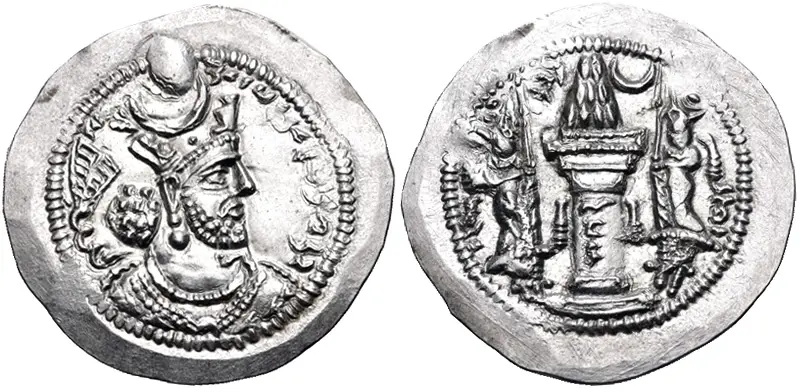
The most common coins in Sasanian Iran were drahms — silver coins weighing approximately 4 grams. Alongside full‑weight drahms, silver coins of proportionally smaller or larger weights were also in use:
- Hemidrahms (1/2 of a drahm);
- Obols (1/6 of a drahm);
- Tetradrahms (4 drahms).
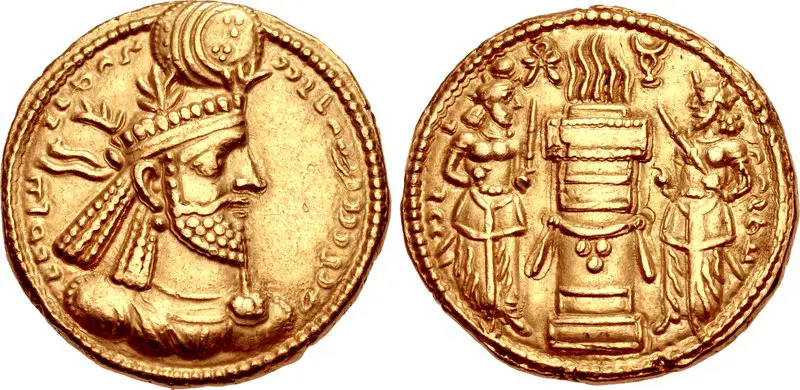
In addition to silver drahms, the Sassanids also minted — though far less frequently — gold coins weighing about 7 grams: the denars. Due to their high value, these were issued in limited batches and held almost exclusively ideological (rather than economic) significance. In this sense, they can be compared to modern commemorative coins.
Besides silver and gold, Sasanian Iran also produced copper (and occasionally lead) coins. However, their series were very small, and they played a negligible role in monetary circulation.
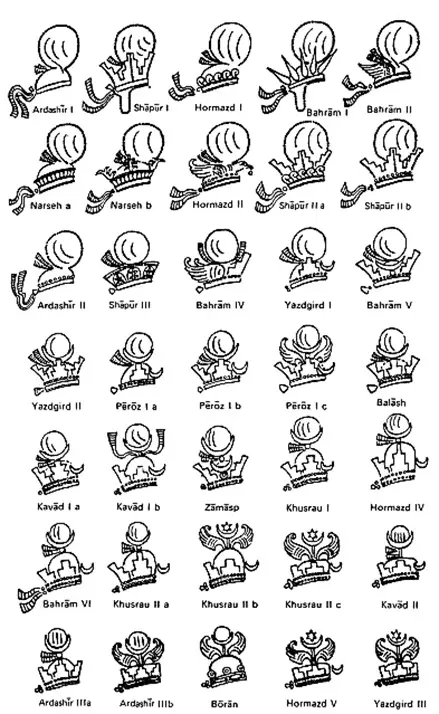
An essential feature of Sasanian coins was the presence of the king’s portrait, depicted in profile on the obverse, along with an inscription of his name. For historians, it is not so much the images themselves that are important, but rather the forms of the royal crowns (kulahs). Each Sasanian ruler had a unique crown design, and by comparing the kings’ portraits on coins with their depictions on, for example, rock reliefs or silver plates, scholars can precisely determine which Sasanian monarch is represented on a given relief or toreutic artifact.
1 The Cambridge History of Iran. Vol. 3. Pt. 1. The Seleucid, Parthian and Sasanian Periods / Ed. by E. Yarshater. Cambridge etc.: Cambridge University Press, 1983. P. 135.