
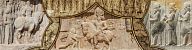
The Persian Sasanian dynasty derived its name from the founder of the lineage from which its rulers descended. This man was called Sasan, and his biography — as often happens in such cases — is shrouded in mystery.
Several versions of Sasan’s origin survive in Persian historical writings. According to one (apparently the earliest, reflected in the so‑called Book of the Acts of Ardashir and later repeated with minor changes by Ferdowsi in his Shahnameh), he was a descendant of the last king of the ancient Persian Achaemenid dynasty, who perished in the struggle against Alexander the Great — Darius III (336–330 BCE).
According to one of the most renowned Persian‑Arab medieval historians, Tabari (839–923), who wrote the monumental work History of the Prophets and Kings (published today in 40 volumes!), Sasan was a Persian aristocrat and keeper of the temple of the Zoroastrian goddess Anahid.
The least romantic (and in a way the most scandalous) interpretation of Sasan’s origins comes from the early Byzantine historian and writer Agathias (536–582). According to Agathias, Sasan was “a certain military man” who happened to stay in the house of a cobbler (!) named Papak, who was also a fortune‑teller. Papak determined that the guest’s descendants would become “the most famous and renowned, attaining great fortune.” Since Papak had no daughters, sisters, or other female relatives to wed to Sasan, he brought his own wife together with the guest. Nine months later, she gave birth to a son — the future founder of the Sasanian state, Ardashir I (224–242 CE).
Most likely, we will never know which of the three versions corresponds to historical reality. However, they all agree on one point: the rise to power of Sasan’s descendants is linked to the name of Ardashir, who was either Sasan’s son or grandson.
Ardashir raised a revolt against the then‑ruler of Iran — King Artaban V (208–224 CE) of the Parthian Arsacid dynasty (note: the Sassanids, unlike the Arsacids, were Persians). Ardashir I managed to win over most of the Iranian nobility — including the Parthian part of it — and overthrew Artaban by defeating his army in the Battle of Hormizdagan (near the modern city of Shushtar in western Iran).
In the following years, Ardashir subjugated the entire territory of the former Parthian kingdom, as well as several neighbouring regions (including a large part of Afghanistan and the south of Central Asia), and rightfully proclaimed himself “King of Kings.”
Thus, on the site of the Parthian kingdom — weakened by struggles with Rome and torn apart by internecine wars — a new mighty empire arose. For over four centuries, it stood alongside the Roman‑Byzantine Empire as one of the two world powers of its time.
The further history of Sasanian Iran can be divided into two main stages, roughly equal in duration:
- The era of the early Sassanids (3rd–4th centuries CE);
- Late Sasanian Iran (5th century – early 7th century CE).
The early period is characterised, on one hand, by the formation of a renewed system of state administration (which, at first, successfully utilised many elements — what we would now call “achievements” — of the earlier Parthian era). On the other hand, it was marked by an extremely aggressive foreign policy in the west (wars with Rome and Armenia), south (wars with the Arabs), and east (wars with states and peoples of eastern Iran, northwestern India, and Central Asia).
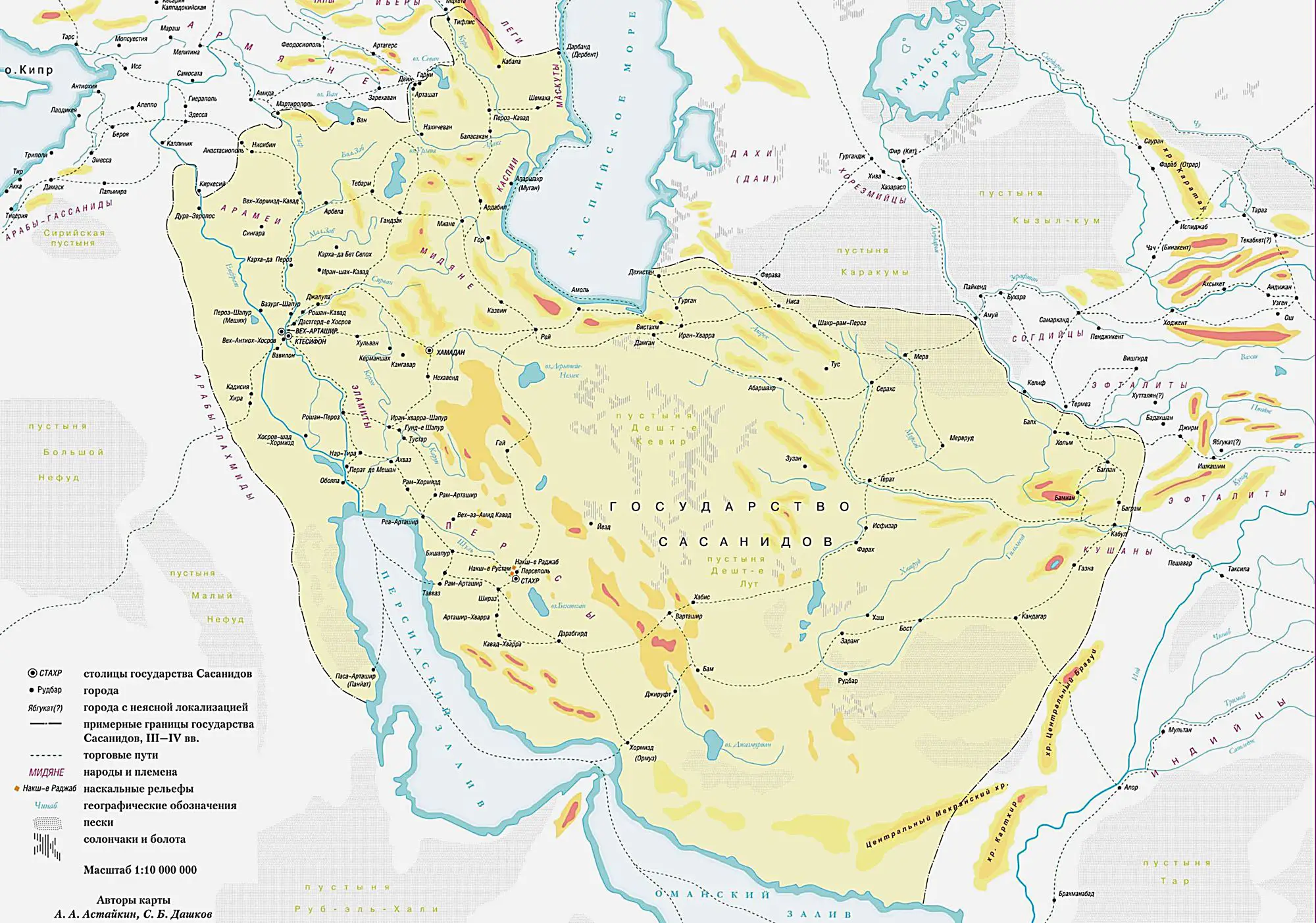
As a result of incessant wars, a vast empire emerged, stretching from the Euphrates in the west to the Indus basin in the east, and from the Caspian Sea in the north to the coast of the Indian Ocean in the south.
From the late 4th century, after the exceptionally eventful reign of King Shapur II (309–379 CE), a certain calm set in, and the Sasanian state entered a new period of its history — one that can be conditionally and somewhat poetically called the period of might and prosperity.
Indeed, the rulers of earlier centuries had conquered vast territories; Iran rightfully considered itself an empire equal to Eternal Rome (and in some ways surpassing it). Now, it was necessary to consolidate the achieved results and modernise the system of governance — shifting its focus from military expansion to addressing long‑term political, social, economic, and historical tasks.
The 5th century can be seen as a prologue to future flourishing — and in a sense, a transitional period. After the first two turbulent centuries of its history, the Sasanian state experienced a series of serious internal and external crises. Overcoming them required major adjustments both in the system of state governance and in the strategy of foreign policy. These very adjustments led to the emergence of the great — in every sense — “State of the Khosrows” (late Sasanian Iran), which became the foundation for nearly all subsequent Islamic statehood and culture.
In the 6th century and early 7th century, the Sasanian empire reached the peak of its might — perhaps culminating during the reign of Khosrow I the Great (531–579 CE). This time, by analogy with Ancient Greece, can also be called the classical era in the history of the Sasanian kingdom. The vast majority of surviving achievements of Sasanian Iran in various spheres of life — especially in spiritual and material culture — date to this period.
However, no era of prosperity lasts forever. The Sasanian Empire eventually entered a phase of gradual decline and eventual collapse. By the late 6th and early 7th centuries, the state appeared to have reached the zenith of its glory. A striking manifestation of this peak was the Persians’ success in the war against Byzantium (602–628 CE). At one point, Sasanian forces — supported by Avars and Slavs — were preparing to assault Constantinople itself!
Yet the brilliant Byzantine emperor Heraclius (610–641 CE) delivered a series of crushing blows that resulted in Iran’s defeat and the return of all previously lost territories to Byzantium.
The sudden reversal in what had seemed a triumphant war plunged the Sasanian state into a profound political crisis. Perhaps, as had happened many times before, the empire could have overcome this crisis and restored its status as a world power. But fate intervened: this was precisely the moment when Islam emerged, and a new military‑political force appeared on the historical stage — the Arab Caliphate.
Weakened by the recent war with Byzantium, the Sasanian Empire could not mount an effective resistance to this new adversary. It fell swiftly under the onslaught of the Arab‑Muslim armies.
The decisive encounter — the Battle of Qadisiyyah — took place in 636 CE and ended in a devastating defeat for the Sasanian army. The days of the Sasanian kingdom were numbered.
Within just 15 years, the entire territory of the empire was overrun by the Arabs. In the very year that Islamic forces finally subdued Iran (651 CE), the last Sasanian monarch, Yazdegerd III (632–651 CE), met his end at the hands of a greedy miller‑peasant, abandoned by all.
The events of the 630s–650s CE marked not only the demise of the Sasanian Empire, but also the dawn of a new era — the Islamic period — in the history of the Middle East and adjacent regions.
1 The name “Khosrow” (or “Khosrov”), borne by one of the greatest rulers of Sassanid Iran, Khosrow I (531–579 CE), later became a byword and was perceived by posterity as a title for ancient Iranian rulers. By the same logic, the name Ca Caesar became the basis for the titles “caesar” (Russian “tsar”), while the name of the Frankish emperor Charlemagne evolved into the word “king”.