
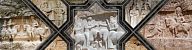
During the Sassanid dynasty’s rule, slightly more than 30 kings sat on the Persian throne (though some were usurpers who seized power illegally). While not all were equally talented — and few can be counted among the great historical figures — a number of Sassanid rulers can rightfully be included among the outstanding monarchs of their time.[1]
The founder of the Sassanid state, Ardashir I (224–242 CE), was the grandson (or, according to another version, the son) of the legendary Sasan — the dynasty’s founder. Ardashir I laid the foundations of the Sassanid empire by defeating the last Parthian king, Artaban V (216–224 CE), in the Battle of Hormizdagan (224 CE) and establishing control over all territories formerly ruled by the Parthians.
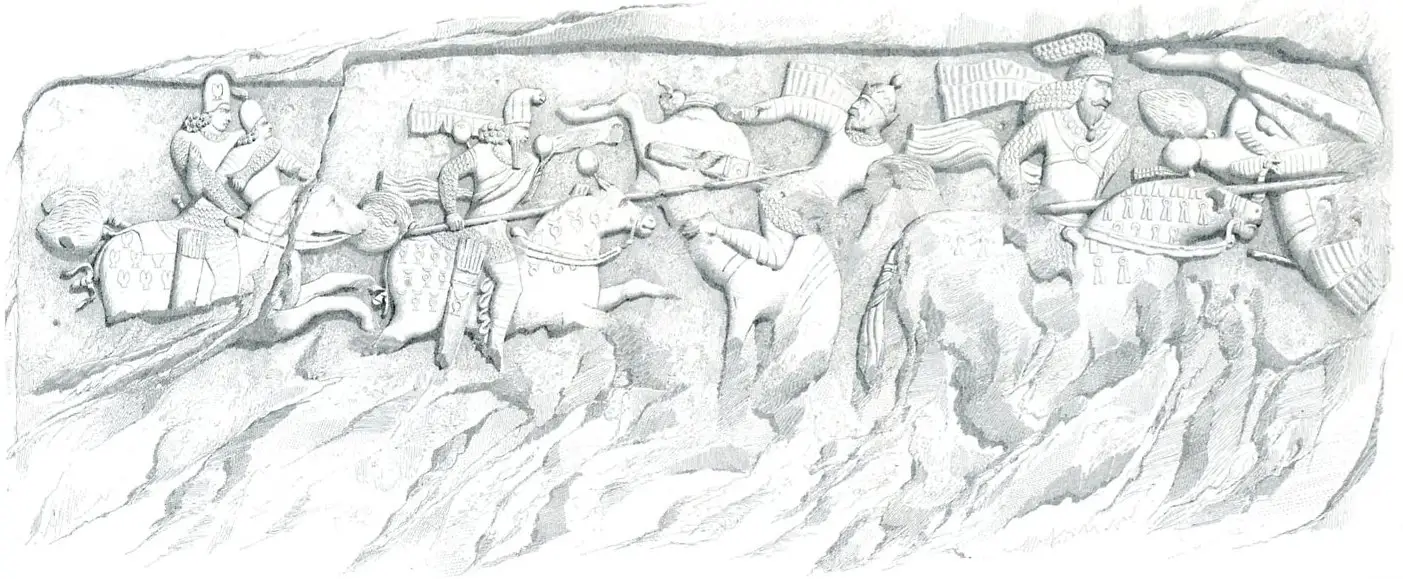
However, while the Parthian kings’ rule over Iran and neighbouring regions was largely nominal, the Sassanids under Ardashir I established firm control over the former Parthian domains, largely curbing the former privileges of the local nobility. Moreover, Ardashir was the first Sassanid to confront Rome, achieving a decisive victory over the Roman emperor Alexander Severus (222–235 CE) in 232 CE.
Yet despite his achievements, Ardashir cannot yet be considered the creator of the Sassanid Empire. It seems he himself understood this, limiting his ambitions to the traditional borders of Iranian empires — as indicated by his title: “King of Kings of Iran”.
The first Sassanid ruler to extend control beyond Iran’s borders — including Armenia and other neighbouring states — and to create a true world empire was Ardashir’s son, Shapur I (242–272 CE). This was reflected in the royal titulature: from Shapur I onward, Sassanid monarchs were called “Kings of Iran and non‑Iran” — a title akin to the ancient Eastern “King of the Four Quarters of the World” (i.e., ruler of the entire world).
Beyond territorial expansion, another key reason for this new title was Shapur’s capture of the Roman emperor Valerian (253–260 CE) during one battle. Valerian was forced to serve Shapur as a slave — holding his back as a step whenever the king mounted his horse. This was unprecedented in the centuries‑long history of Roman‑Persian conflict.
At the turn of the 3rd–4th centuries CE, the Sassanid state faced its first major political crisis. It emerged from this crisis in the 20s of the 4th century CE under Shapur II the Great (309–379 CE). According to a legend widespread among medieval Persian historians, Shapur II was proclaimed king before his birth: with no other suitable candidates (nearly all potential heirs had died in internecine struggles), the court nobility placed the royal crown on the belly of Shapur’s pregnant queen.
Of all the Sassanids, Shapur II can perhaps most justifiably be called a conquering king. From 325 CE, when he reached adulthood, his reign was marked by near‑constant wars — fought successfully on all fronts: the Arabian Peninsula, Armenia, Syria, Eastern Iran, and Central Asia.
Shapur was not merely a conqueror but a ruthless one. After Persian invasions of Arabia — retaliation for devastating Arab raids — the Arabs nicknamed him “Dhu’l‑Aktaf” (“The One with Shoulders” or “The Shoulder‑Cutter”). According to Persian historians, “until his death, Shapur was obsessed with exterminating the Arabs and cutting out the shoulder blades of their leaders.” In one punitive expedition alone, the shoulder blades of 50,000 Arabs were cut out — an unparalleled cruelty even for that time.
Shapur II’s wars with Rome were also highly successful. Following the defeat of the Roman army in 363 CE and the death of emperor Julian the Apostate (361–363 CE), the Roman Empire was forced to sign the humiliating Treaty of Nisibis, ceding important regions and cities in Mesopotamia and Armenia to Iran. In the east, Shapur II expanded the Sassanid borders by seizing part of the former Kushan realm.
After Shapur II’s death and throughout the 5th century, Sassanid Iran faced difficult external (nomadic incursions on northern and eastern borders) and internal (noble conspiracies and social movements) challenges. As a result, the Sassanids could not pursue the same active policies as their 3rd–4th century predecessors. Persia even had to seek closer ties with Rome to jointly defend against nomadic invasions from the North Caucasus.
Among the kings of this period, Bahram V Gur (421–439 CE) stands out — not for military or administrative achievements (in this regard he was rather mediocre, if not weak), but as a hero of numerous legends and tales. According to Soviet Iranologist M.M. Dyakonov: “Stories of his hunting exploits and love adventures — widespread already in Sassanid times — became favourite themes in the folklore, literature, and visual art of many Near Eastern peoples... Thus, a negligible ruler who handed over full power to the nobility and devoted himself to pleasures and amusements transformed into a wondrous knight endowed with supernatural qualities.”[2]
Another, as L.N. Gumilev would say, “passionate” personality emerged on the Sassanid throne in the mid‑6th century. This was Khosrow I the Great (531–579 CE), or Khosrow Anushirvan (“Khosrow of the Immortal Soul”), as Persian historians called him.
Under Khosrow, Iran entered a period of flourishing. The king implemented wide‑ranging internal reforms, begun by his father, King Kavad (488–531 CE). Key changes included:
- Administrative reform: the empire was divided into four regions, each headed by a royal governor, centralising power.
- Military reform: the state was split into four military districts (kusts), each led by a “commander of the army” (spahbed) directly subordinate to the king.
- Creation of a standing army: funded by the state, this force could undertake larger operations than the previous noble militias (azads).
These reforms enabled Khosrow Anushirvan to pursue ambitious foreign policy goals. Under his rule, Iran:
- Successfully contested the Byzantine Empire;
- Expanded its borders in the Caucasus and Arabia (including Yemen);
- Repelled nomadic incursions (by the Hephthalites and later the Turks) on its northeastern frontiers (modern Afghanistan).
Khosrow left his successors a prosperous empire, rivalling Byzantium in power and shaping Eurasian geopolitics. Yet this golden age proved short‑lived.
Already under Khosrow’s son and successor, Ormuzd IV (579–590 CE), Iran faced a new internal crisis. The main cause was the Persian aristocracy’s discontent over the loss of privileges during Khosrow I’s authoritarian rule. Through court intrigues, Ormuzd was deposed and later executed.
In the ensuing power struggle, the last ruler under whom the Sassanid state retained its status as a great power came to the throne — Khosrow II Parvez (“The Victorious”) (591–628 CE). Notably, he gained power with military and financial support from the Byzantine Empire.
However, Khosrow II’s reign proved fatal for Sassanid Iran. His war with Byzantium — launched successfully in 602 CE against Emperor Phocas (602–610 CE), who had overthrown Emperor Maurice (582–602 CE) (the same ruler who had once helped Khosrow ascend the throne) — ended in 628 CE with the complete defeat of the Persian Empire.
Soon after, Khosrow Parvez was murdered by his own courtiers. The final years of the Sassanid state were marked by turmoil and internecine wars.
The reign of the last Sassanid king, Yazdegerd III (632–651 CE), can be metaphorically described as a tragedy that turned into farce. He faced Arab armies driven by a new religion — Islam — who fought fearlessly against both Persians and Byzantines.
While Byzantium managed — at great cost (losing Egypt, Palestine, and Syria forever) — to halt the Arabs at the border of Asia Minor, Sassanid Iran fared far worse. At the Battle of Qadisiyyah (636 CE), the Arabs decisively defeated the Persians, leaving the Sassanid realm defenceless.
Yazdegerd III tried in vain to organise resistance against the Arabs. Ultimately, as noted above, he fell victim to a greedy peasant. The peasant, coveting the king’s rich garments, killed Yazdegerd — who had sought shelter for the night — and threw his body into a canal. It is hard to imagine a more ignominious end for such a once‑great dynasty...
1 A comprehensive historical and biographical overview of the Sassanid dynasty is contained in: Dashkov S.B. Kings of Kings — Sassanids. Iran in the 3rd–7th Centuries in Legends, Historical Chronicles, and Modern Research. Moscow, 2008.
2 Dyakonov M.M. Essay on the History of Ancient Iran. Moscow, 1961, p. 274.