
Saint Stepanos Monastery - A Sacred Chronicle of Survival and Renaissance
The history behind the monastry's existance
Saint Bartholomew the Apostle first founded a church at the site around AD 62, during the Parthian era.The first monastery was built in the seventh century, and was later expanded in the 10th century. The monastery was damaged during the wars between the Seljuks and the Byzantine Empire in the 11th and 12th centuries.
Following the conquest of the region by the Mongols of Hulagu Khan, grandson of Genghis Khan, in the middle of the 13th century, a peace agreement was signed between the Armenian Church and the Ilkhanate, and the Christians maintained an equable situation. The monastery was restored in the second half of the 13th century, and was completely rebuilt under the leadership of Zachariah in 1330. By the 14th and 15th centuries, the Saint Stepanos Monastery was at the height of its cultural and intellectual influence, producing paintings and illuminated manuscripts in religion, history, and philosophy.
In the early 15th century, the new Safavid dynasty protected the Armenians, but the region was at the center of the conflicts with the Ottomans, who invaded Western Armenia in 1513. The monastery gradually declined in the 16th century. Abbas the Great expelled the inhabitants of the region in 1604, and the monastery was abandoned. After 1650, the Safavids reoccupied the region and the abandoned monastery was restored in the latter part of the 17th century.
At the beginning of the 18th century, the region came under the expansion of the Russian Empire. Yerevan was conquered by the Russians in 1827, and per the Treaty of Turkmenchay, the border between Iran and Russia was subsequently established on the Araxes. Consequently, part of the population was forcefully displaced to Russian Armenia. The Qajar rulers continued to protect the Armenians, and encouraged the rebuilding of the Saint Stepanos Monastery between 1819 and 1825.
Architectual features
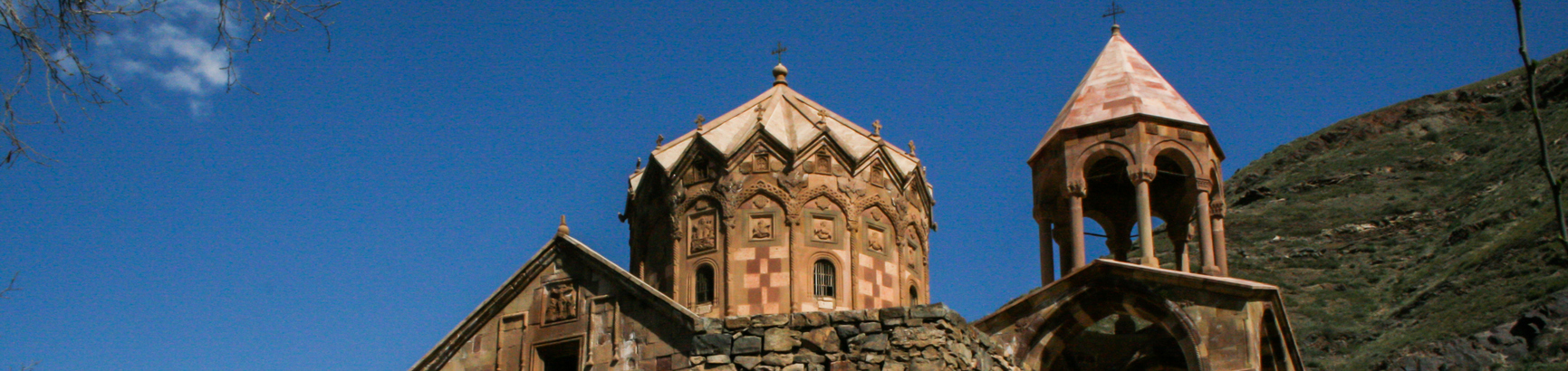
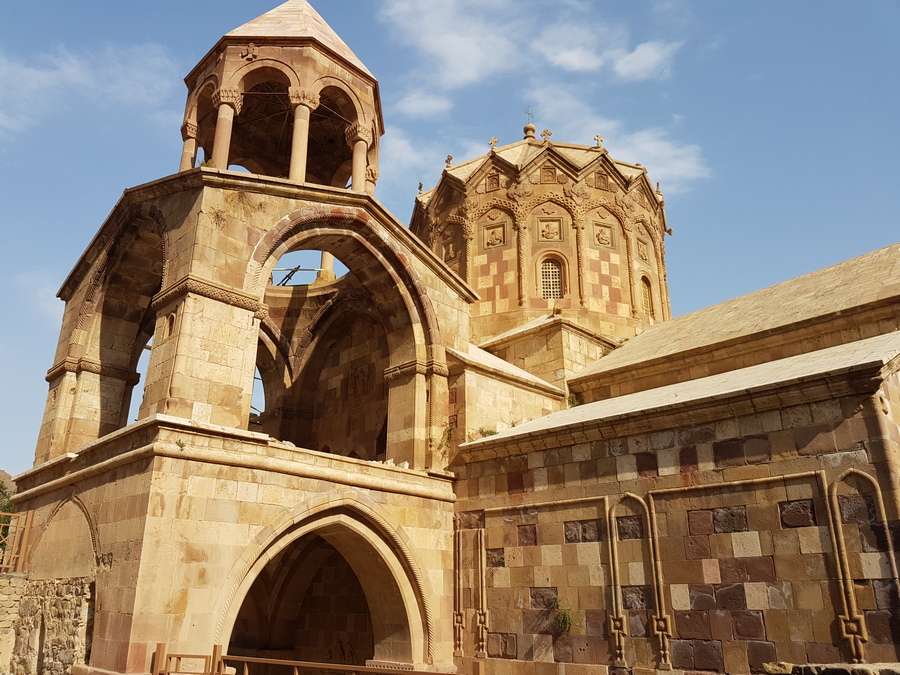
The Monastery of Saint Stepanos in Jolfa, near Tabriz, is a stunning example of Armenian ecclesiastical architecture infused with Persian artistic influences. Originally built in the 9th century and later reconstructed during the Safavid era, the monastery is nestled in a dramatic canyon near the Aras River, close to the Iranian-Armenian border. Its architectural style is a fusion of Urartian, Parthian, Roman, and Armenian traditions, evident in its cylindrical bell tower, central dome, and intricately carved stone façades. The main chapel, bell tower, and the Fireplace of Daniel form the core of the complex, while the walls are adorned with biblical reliefs and geometric motifs that reflect both spiritual devotion and artistic mastery.
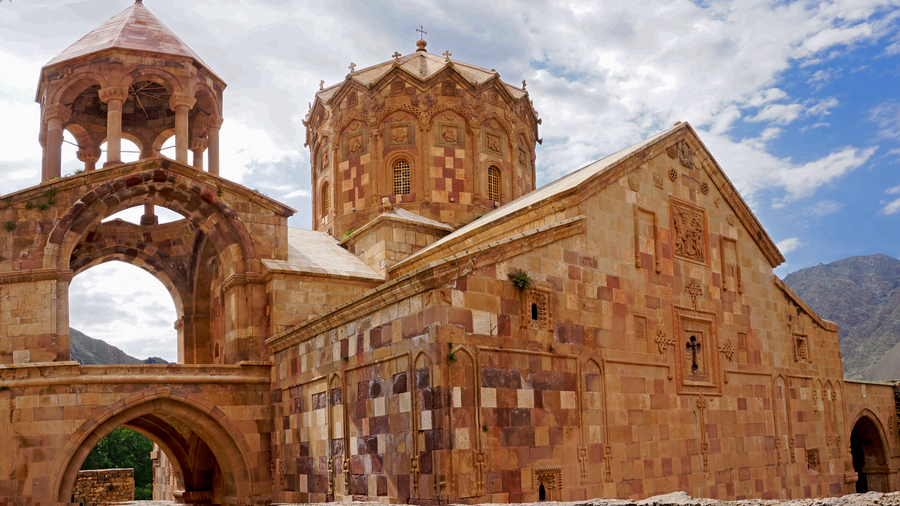
The monastery’s design also includes a religious school and a museum, making it not only a place of worship but also a center of learning and cultural preservation. The entrance to the church is particularly striking, framed by elaborate carvings of angels and saints, which narrate stories from early Christianity. As part of the UNESCO-listed Armenian Monastic Ensembles of Iran, Saint Stepanos Monastery stands as a testament to the resilience and richness of Armenian heritage in the region. Its remote location and historical significance have made it a pilgrimage site for Armenian Christians and a symbol of interwoven cultural narratives between Iran and Armenia.
I want to visit
Monastery of Saint Stepanos






Monastery of Saint Stepanos
Visitor Information
- Opening Hours:
- Monday: 09:00 – 17:00
- Tuesday: 09:00 – 17:00
- Wednesday: 09:00 – 17:00
- Thursday: 09:00 – 17:00
- Friday: 09:00 – 17:00
- Saturday: 09:00 – 17:00
- Sunday: 09:00 – 17:00
- Entrance: For free
- Region: East Azerbaijan Province
- City: Jolfa
- Address: Jolfa, Sahel Street, Seventh Sahel Street
- Postal code: 5137653363
- Phone number: +984135565388
- Is open to public visitors: Yes