
Discover Saint Mary Church: A Hidden Gem in Tabriz
- Introduction
- Historical Background
- Architecture of Maryam Church
- Armenian Museum of Tabriz
- Sightseeing near The Church of the Saint Mary
The Church of the Saint Mary is not only the oldest church in Tabriz, but also the largest. Its remarkable antiquity makes it a significant part of the city’s historical and cultural identity. Additionally, it is the site of the Armenian Apostolic Church’s major religious ceremonies—some of the most prominent in the country. Its central location makes it easily accessible from various parts of Tabriz.
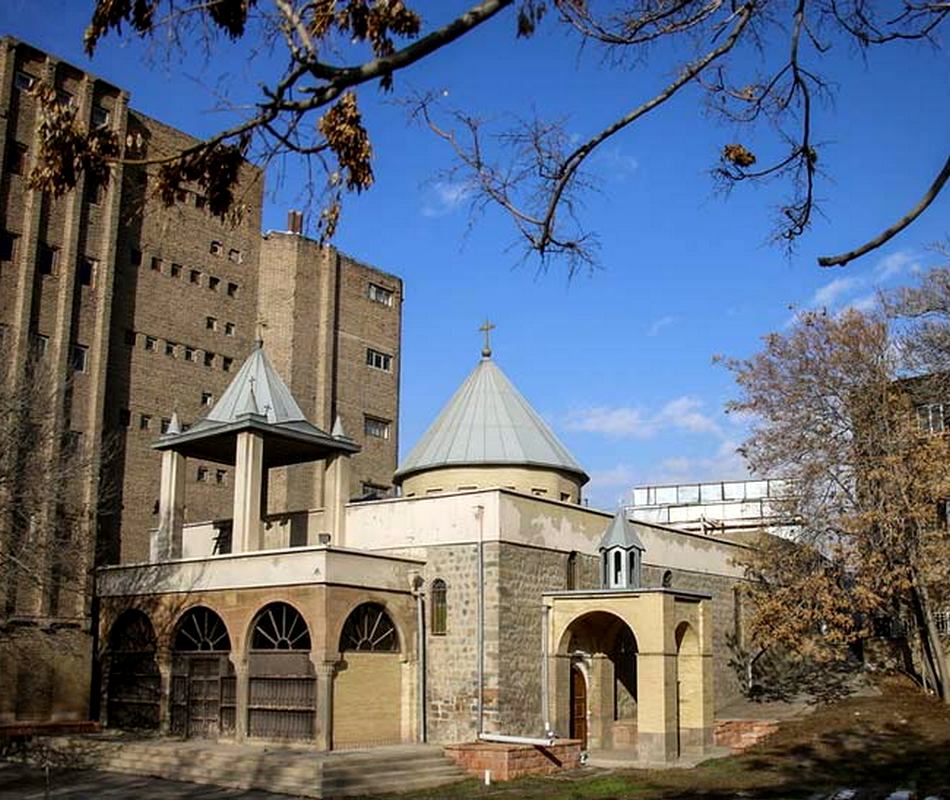
Situated at the intersection of North Shariati (formerly Shahnaz) and Jomhuri Avenues in the historic Dik Bashi neighborhood, the church stands at the heart of the city. For many years, Saint Mary’s served as the seat of the Armenian Archbishop of Azerbaijan. It is a beautifully constructed edifice, surrounded by annex buildings spread across a large area. The church is actively maintained by a board of Armenian elders, and next to it stands the Tabriz Armenian Museum, operated by the Armenian Prelacy of Tabriz.
Introduction
The Church of the Saint Mary is one of the most notable historical landmarks in Tabriz, and is both the oldest and largest church in the city. It is the venue for the national religious ceremonies of the Armenian Apostolic Church in Tabriz. The Armenian Apostolic Church—often simply referred to as the Armenian Church—is attended exclusively by Christian Armenians. The church is located within the Christian quarter of the city, along Shariati (Shahnaz) Street.
Historical Background
Based on the oldest tombstone found on-site, the church likely dates back to between 879 and 979 Solar Hijri years (1500–1600 AD), which corresponds to the Safavid period. However, the architectural style of its entrance is reminiscent of the Ilkhanid era, suggesting that the church may have been built as early as the 13th or 14th century (7th century AH / 1200–1300 AD). This theory is supported by a reference made by Marco Polo (1254–1324) during his journey to China, in which he mentioned this very church.
During the early Ilkhanid period, before the dynasty converted to Islam, Christians and Christianity enjoyed significant status and influence at the royal court—particularly from the reign of Hulagu Khan (651–663 AH / 1256–1265 AD) to that of Ghazan Khan (694–703 AH / 1295–1304 AD). As such, the church may have been established during this tolerant era. Nevertheless, the Safavid-period tombstone indicates that the church remained active during the Safavid dynasty.
Following the devastating Tabriz earthquake in 1158 AH (1780 AD), the church suffered severe damage and required reconstruction. This restoration began in 1161 AH (1782 AD) and took three years to complete, employing the architectural style of the Safavid era. While there is no official record of government opposition to its reconstruction, Armenian oral tradition holds that the authorities disapproved of erecting a church in the Islamic city of Tabriz. As a result, the church was supposedly built at night—a legend recounted in the travelogues of Tavernier and Chardin, both of whom lived during the Safavid period, suggesting the story predates the reconstruction.
Architecture of Maryam Church
The church is built in the traditional Armenian architectural style, featuring a cruciform layout and a central dome supported by four thick stone columns. Above the main entrance, a small marble plaque inscribed in Armenian script indicates the date of the church’s foundation. The entrance hall is flanked by eight stone columns, upon which two church bells are mounted.
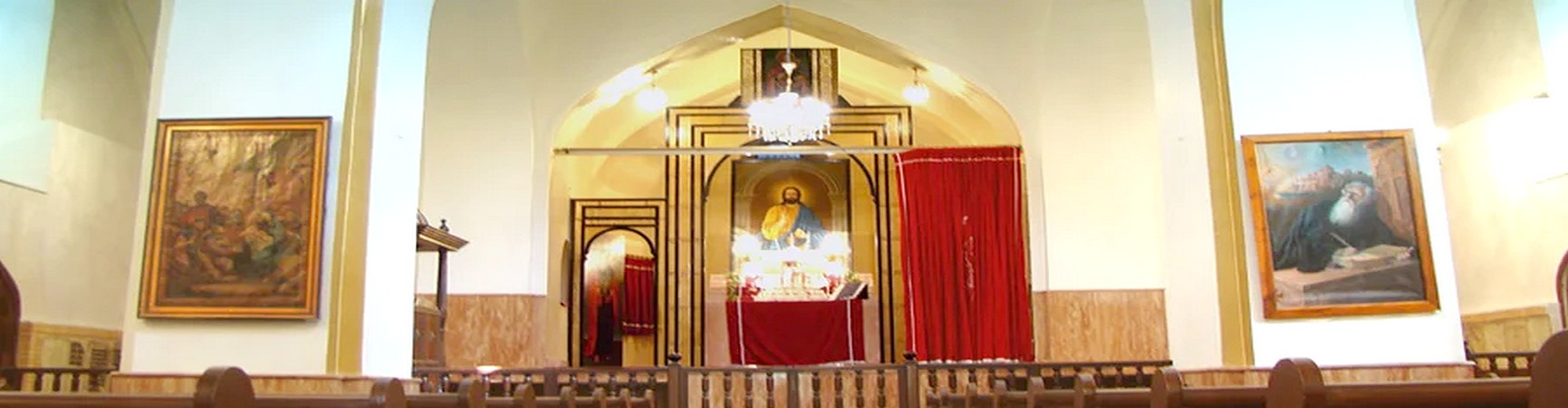
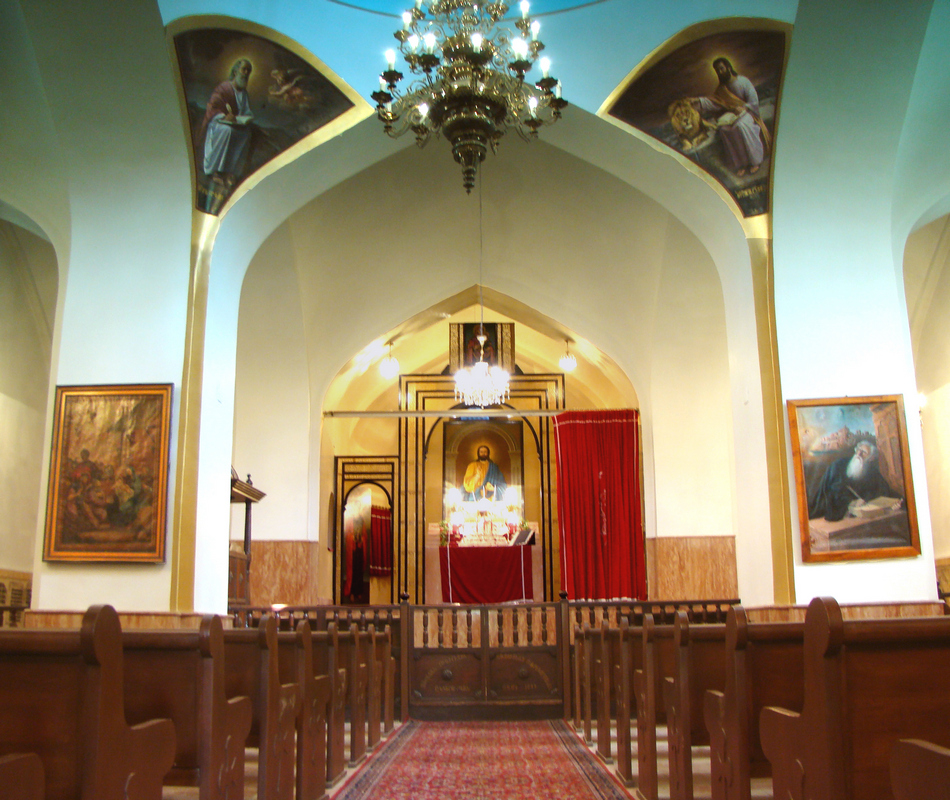
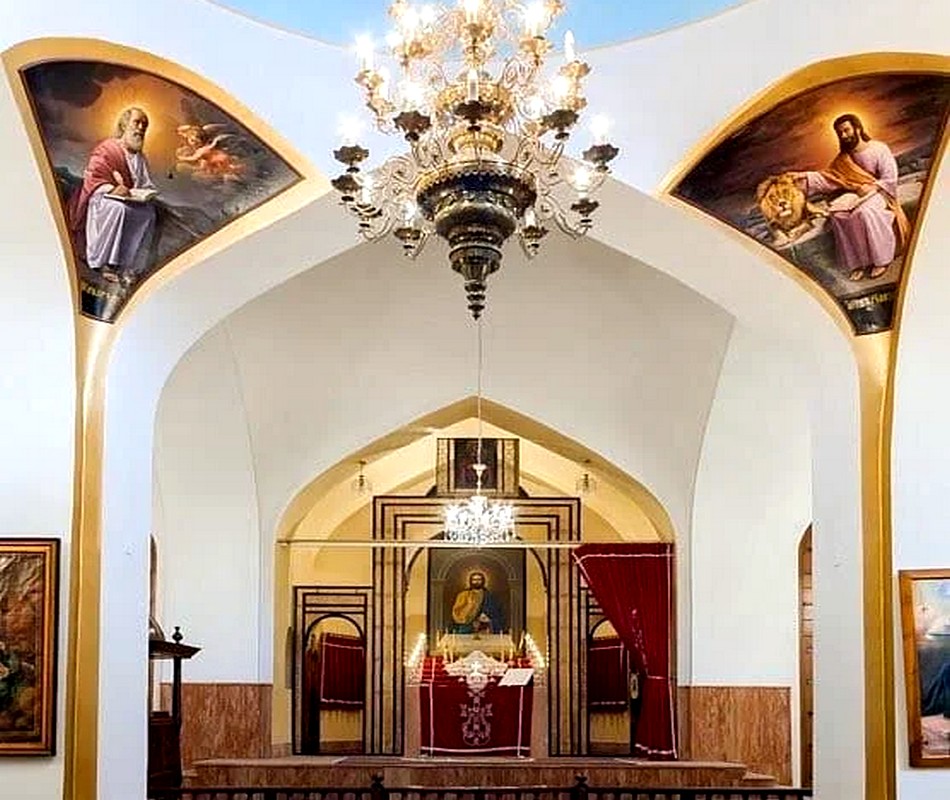
Inside, the church contains striking images of the Virgin Mary, Jesus Christ, the apostles, and various saints. Originally, four painted curtains adorned the main columns; however, two were lost to humidity, while the remaining two—on the north and south walls—have survived. These original artworks were painted on leather and affixed to the walls. Today, they have been replaced with canvas murals, making the church unique among Iranian churches in this regard.
Canvas murals—paintings made on canvas and then attached to architectural surfaces—originated in Renaissance Europe. When removed from their original setting, the structural and artistic unity of such murals is often compromised. In Iran, only a few churches feature this technique, including the Church of the Holy Virgin Mary in Tabriz, the Vank Cathedral, and Saint Mary Church in Isfahan.
The current murals were created after the original paintings were lost. The Armenian Caliphate at the time invited a skilled artist, Andranik Simbarian, from Armenia to repaint them. He reproduced the images based on the earlier versions and installed them under the central dome in the narthex. These new murals, executed in the miniature style of late 12th-century AH (early 1800s) Iran, were painted in oil with clear European stylistic influences.
The church also features a courtyard planted with trees. Notably, it once hosted one of Tabriz’s first printing presses. In 1267–1268 AH (1889 AD), Bishop Stepanous Mukhtiarian imported the press to support the Aramean school, and it was installed within the church grounds.
Armenian Museum of Tabriz
Located on the church premises, the Armenian Museum of Tabriz is one of the city’s lesser-known yet culturally rich attractions. It houses numerous historical artifacts, many of which are deeply connected to Armenian heritage. The museum operates under the supervision of the Armenian Caliphate of Azerbaijan and is also known as the Museum of Churches of the Armenian Caliphate.
Museum Collection
The museum holds a diverse collection of historical books, both printed and handwritten, in Armenian, Persian, and Arabic. Among these are 35 Armenian manuscripts written on deerskin in Hebrew script. Important works preserved here include Khamseh of Nezami, Zhakir Khorazmshahi, Mi'raj al-Nubuwwah, and an Armenian translation of the Holy Bible.
In addition to its literary treasures, the museum houses a range of valuable artifacts: ancient jewelry, coins, statues, ornaments, textiles, and wooden furniture—including a table and a carved chair dating back to 1728. Other items include old crosses, clerical garments, royal crowns, scrolls, imperial decrees, oil paintings, weapons, walking canes, silverware, copper and porcelain pieces, crystal, wooden artworks, bells, and chimes.
These items were gradually donated or transferred to the museum by Armenian families. Among the most treasured pieces is a velvet-covered carved chair made in 1728 for the Archbishop of the Armenian Church of the Holy Cross on Akhtamar Island (in Lake Van), along with his staff (1825) and bell (1831). These were relocated to Tabriz during the upheavals of 1895. At that time, various church items—including crowns, emblems, large candlesticks from the churches of Saint Stephen and Qara Church, and the large bell and inlay of this church—were transferred to Tabriz as well.
Sightseeing near The Church of the Saint Mary:
You can visit The Blue Mosque of Tabriz which is located near The Church of the Saint Mary in Tabriz.
I want to visit
Tabriz Saint Mary Church






Tabriz Saint Mary Church
Visitor Information
- Opening Hours:
- Monday: 09:00 – 17:00
- Tuesday: 09:00 – 17:00
- Wednesday: 09:00 – 17:00
- Thursday: 09:00 – 17:00
- Friday: 09:00 – 17:00
- Saturday: 09:00 – 17:00
- Sunday: 09:00 – 17:00
- Entrance: For free
- Region: East Azerbaijan Province
- City: Tabriz
- Address: Maghsoudieh neighborhood, Tabriz, Islamic Republic Street, Prayer Square
- Postal code: 5137653363
- Phone number: +984135565388
- Is open to public visitors: Yes