

Nowruz: Where 3,000 Years of Fire, Spring, and Hope Meet
- Ancient Origins: A Celebration Older Than History Books
- Evolution Through History: A Tradition That Refused to Fade
- Modern-Day Celebration: Thirteen Days of Renewal
- Why Travelers Should Experience Nowruz
- Plan Your Nowruz Journey
The scent of hyacinths drifts through open windows. Families scrub their homes from ceiling to floor. Somewhere down the street, a bonfire crackles as people leap over the flames, laughing, shouting old words for luck. This is the final countdown to Nowruz - the exact second the earth tips into spring, and an entire nation, and beyond millions of it, hold their breath together.
Nowruz means "new day," and few celebrations on earth have earned that name so completely. It is older than most of the world's living religions, older than many of its nations, and it still arrives every year with the same quiet miracle: the sun crossing the equator, and a nation deciding, together, that renewal is worth celebrating.
Ancient Origins: A Celebration Older Than History Books
Nowruz traces its roots to ancient Persia, at least 3,000 years back, into the Zoroastrian tradition that once shaped the spiritual life of the region. For Zoroastrians, the spring equinox was not just a change in season. It represented the eternal contest between light and darkness, resolving in light's favor. Fire, water, and the natural world were treated as sacred, and the arrival of spring was proof that goodness would always return after the cold retreat of winter.
This is why fire remains central to Nowruz to this day. On the last Wednesday before the new year, a festival called Chaharshanbe Suri fills the streets with bonfires. Jumping over the flames is not just tradition for tradition's sake. Participants ask the fire to take their paleness, their sickness, their misfortune, and hand back its warmth and color instead. It's a ritual of trade: the old year's weight exchanged for the new year's vitality.
Long before calendars and clocks, the people of ancient Persia were already marking this precise astronomical moment with extraordinary accuracy, a testament to how central this turning point was to their understanding of the world.
Evolution Through History: A Tradition That Refused to Fade
Empires rose and fell across Persian lands - Achaemenid , Parthian , Sassanid - and Nowruz endured through them all, gathering new customs the way a river gathers tributes. Even as Islam spread across the region from the seventh century onward, Nowruz proved too deeply woven into daily life to disappear. Rather than erasing it, the tradition adapted, blending with new cultural and religious layers while holding onto its core: renewal, family, and hope.
By the time of the Persian poets, Nowruz had become inseparable from the season itself. Omar Khayyam, the eleventh-century poet and mathematician, wrote of spring's fleeting beauty and its call to seize the moment, capturing in verse the same urgency Nowruz still asks of its celebrants: don't let the new day pass unnoticed.
Khayyam poetry translation by Edward Fitzgerald:
'Ah Breeze of Spring awakening the Rose
How sweet to see my Love on grass repose!
O futile 'tis to talk of days of yore
Enjoy the hour erelong your shadow grows.'
That resilience is really the heart of the Nowruz story. It has never belonged to a single dynasty, religion, or ruler. It belongs to the people, which is exactly why it survived when so much else didn't.
Modern-Day Celebration: Thirteen Days of Renewal
Today, Nowruz unfolds as a rich sequence of Persian New Year traditions that stretch across nearly two weeks, and the preparation begins well before the calendar turns.
Khaneh Tekani , literally "shaking the house," is the Persian version of spring cleaning, but taken to an entirely different level. Every corner is scrubbed, every carpet aired out, every surface polished, all in the belief that a clean home invites a clean start.
At the center of every household sits the Haft-Seen table , a spread of seven symbolic items each beginning with the Persian letter "S": sabzeh (sprouted greens for rebirth), samanu (sweet pudding for abundance), senjed (dried fruit for love), seer (garlic for health), seeb (apples for beauty), somaq (sumac for the sunrise), and serkeh (vinegar for patience and wisdom). Mirrors, candles, painted eggs, and a bowl of goldfish often join them, turning the table into a living symbol of hope for the year ahead.
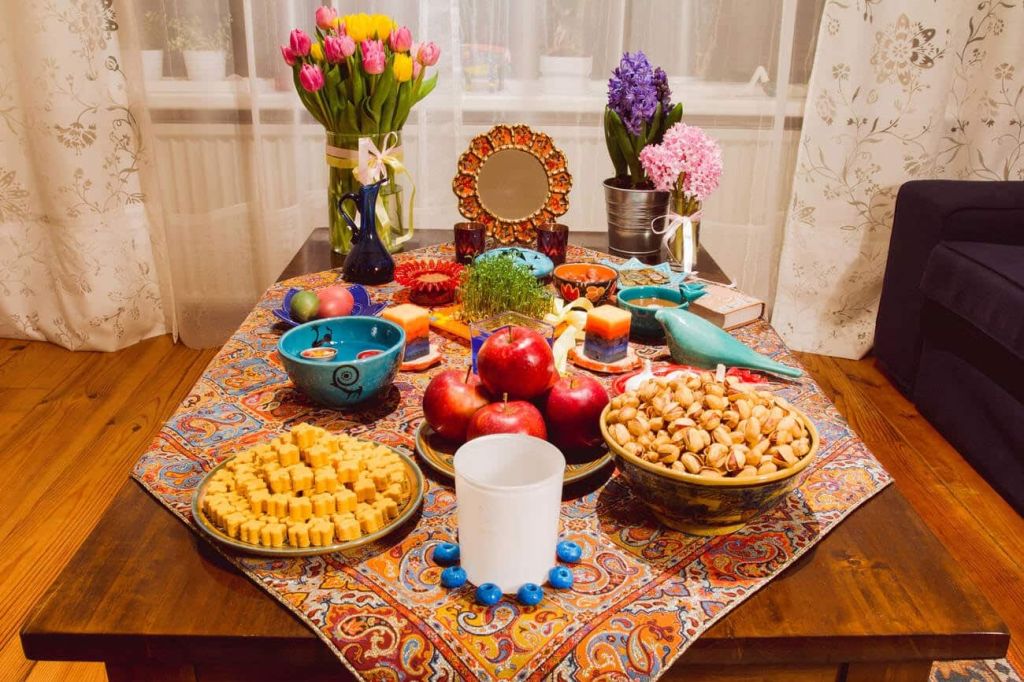
When the exact moment of the equinox arrives, families gather around this table, count down together, and embrace. Elders give gifts to children. Visits stretch across the following days as relatives and friends move from house to house, sharing tea, pastries, and blessings for the year to come.
Nowruz celebrations extend far past Iran's borders too, marked in Afghanistan, Azerbaijan, Tajikistan, parts of Central Asia, and the Caucasus, as well as in vibrant diaspora communities from Los Angeles to London. The specifics shift slightly from place to place, but the spirit of Nowruz traditions remains unmistakably the same.
The festivities close with Sizdah Bedar , the thirteenth day, when families leave their homes behind for parks, gardens, and riverbanks. The sprouted greens from the Haft-Seen table are tossed into flowing water, symbolically carrying away the bad luck of the number thirteen and letting go of anything from the old year still worth releasing.
Why Travelers Should Experience Nowruz
There are festivals you watch, and then there are festivals you're pulled into. Nowruz belongs firmly to the second category.
Arrive in Iran during Nowruz window and you won't simply observe a tradition, you'll be handed tea within minutes of walking through a stranger's door. You'll be invited to leap over a bonfire with people who've never met you but greet you like family the moment you show interest in their customs. You'll watch a bazaar transform into a wonderland of hyacinths, goldfish, and painted eggs, the air thick with the smell of rosewater pastries. Markets and sights packed with people.
This is what makes travel unforgettable: not just seeing a place, but being absorbed into its rhythm at the exact moment it means the most to the people who live there. Nowruz celebrations offer precisely that kind of access - an authentic, unscripted window into a culture defined by warmth, poetry, and resilience.
For travelers drawn to history that still breathes, to rituals that have survived three millennia without losing their meaning, few experiences compare. This is a chance to witness a 3,000-year-old New Year unfold not as a museum piece, but as a living, joyful, deeply human celebration.
Plan Your Nowruz Journey
Spring only tips into place once a year, and Nowruz only arrives with it. If the idea of fire-lit streets, blossom-scented markets, and tables set with centuries of symbolism has stirred something in you, don't let the season pass unnoticed. Explore our private and group tours in March and April to plan your visit and step into a New Year tradition unlike anything else on earth.