
Hasht Behesht Palace
- History of Hasht Behesht Palace of Isfahan
- Architecture of Hasht Behesht Palace of Isfahan
- Nearby Attractions
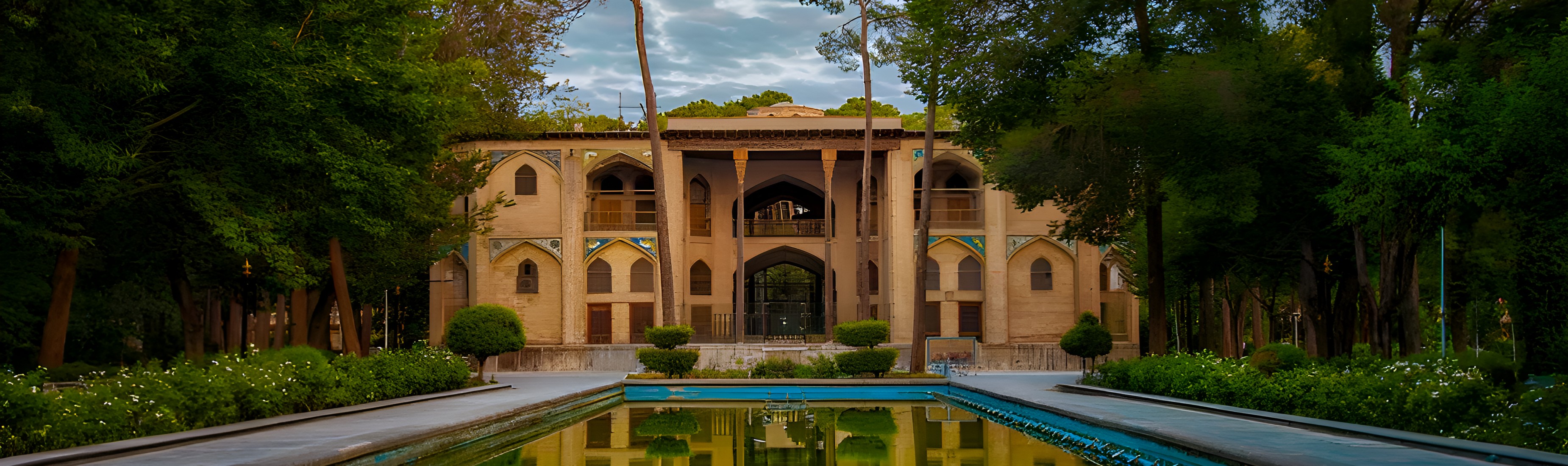
The Hasht Behesht Palace, whose grandeur and beauty have led many tourists to its glory, is one of the most spectacular buildings in the ancient city of Isfahan. This spectacular historical monument is located on the western side of Chaharbagh Street and opposite Sheikh Bahai Street. Other names for Hasht Behesht Palace are Hasht Dar Behesht, Hasht by Hasht, and Bagh Bulbul. This palace is located in Shahid Rajaee Park. Today, nothing remains of the mansion except that a beautiful and enchanting park has been built around it in recent years.
History of Hasht Behesht Palace of Isfahan
Isfahan owes its existence to the Safavid era and its kings. Shah Abbas, the first king of the Safavid Empire, chose Isfahan as its capital. One of his decisions to transform Isfahan into a city worthy of his empire was to build a long street called Chaharbagh and create gardens in it. Unfortunately, none of these gardens remain except for the Forty Column Garden and the Eight Paradises Garden. The word Eight Paradises in Persian means the entrance to heaven. The Eight Paradises Palace was built in 1669 and was called the "most beautiful palace in the world" for a long time. In 1343, this garden was handed over to the Iranian Ministry of Culture and Art. It is interesting to know that some historians believe that the reason for building this building was to create a harem for the residence of the eight-year-old king, and hence the name of this palace was given to the Eight Paradises.
During the Qajar period, this garden was handed over to the first lady, Eftekhar al-Dawlah, with the condition that the architecture of the building would not be changed, but later, following her death, the garden was inherited and underwent many changes. Finally, in 1343, the garden came under the supervision of the Ministry of Culture and Art and was turned into a park. At the same time, the Department of Archaeology asked for help from Iranian and Italian architects and craftsmen to revive the beautiful decorations that had been buried under the stucco work of the Qajar era. This palace was also so glorious that its name appears in the books of travelers and poems of many poets such as Mirza Mohammad Taher Nasrabadi. What you see today from the Hasht Behesht Palace of Isfahan is a building that has undergone many changes over the years; but it is nevertheless one of the most beautiful palaces in Iran.
Architecture of Hasht Behesht Palace of Isfahan
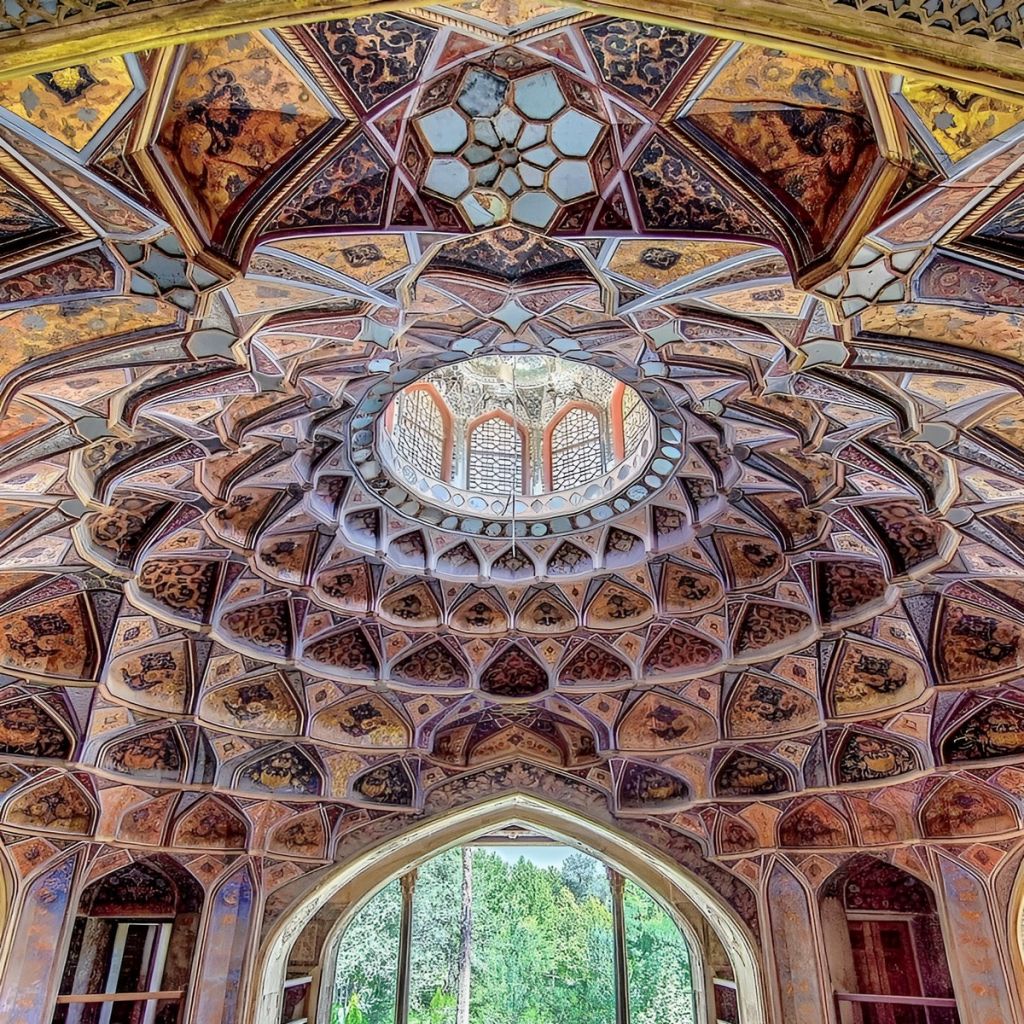
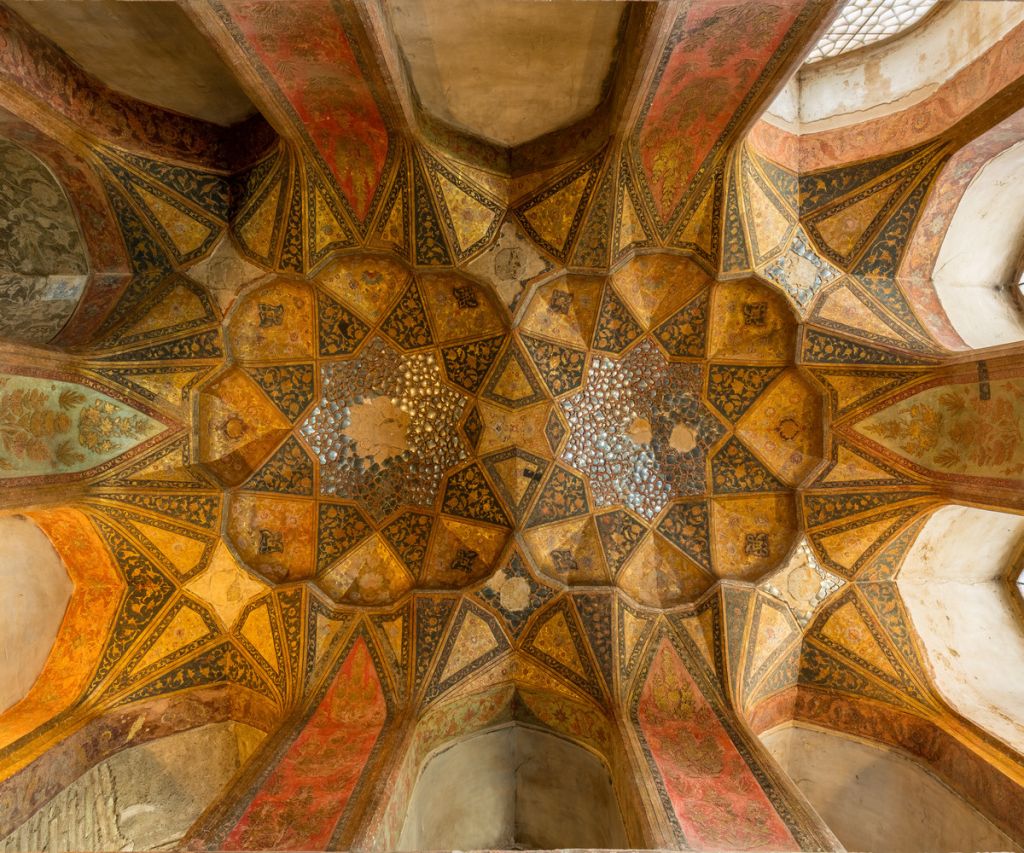
In the middle of the Bulbul Garden, which was itself part of the Jahannam Garden of Isfahan, a two-story mansion has risen. This mansion was built 2 meters above the ground on Tabrizi marble stones with a height of 30 meters to give its guests a better view of the garden. Through two staircases on both sides of the building, one can enter the mansion's porches. The porches are with tall wooden columns decorated with eye-catching stucco. The central part of the palace was built in four phases and its porch faces north. The ceiling is covered with gorgeous stucco moldings, which are called mogharnas in Persian. The rooms on the first floor are decorated with paintings in the four corners of the building. On the second floor, the building has several porches, rooms, arches, and windows that add to its beauty. This floor is divided into corridors and chambers, each with its own unique decorations. In some of these rooms, there is a fountain and a wall-mounted stove. The walls are also covered with many mirrors.
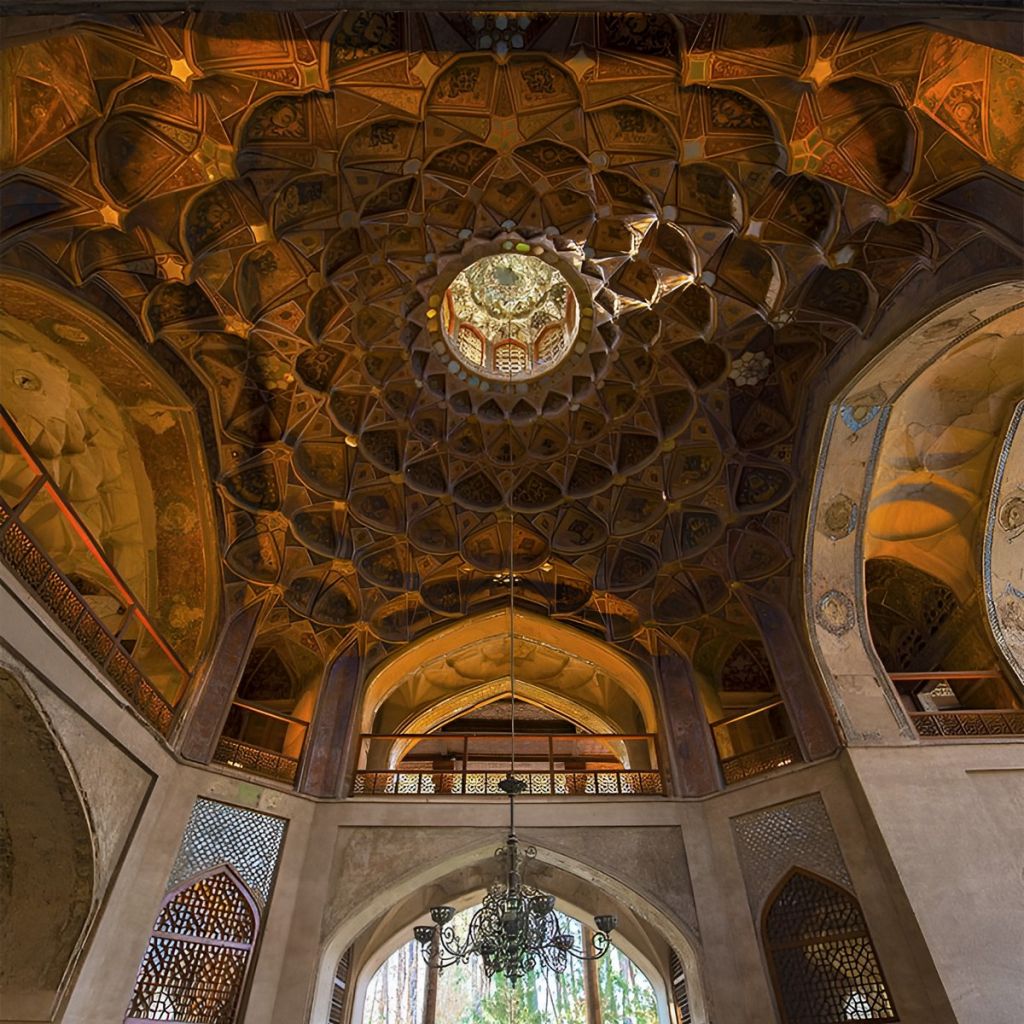
If you look up, the mosaics and mogharnas on the porch ceiling will amaze you. The ceilings are decorated with special artistry in mirrors and glasswork, as well as paintings and gilding. It is not a bad idea to take a closer look at the paintings of the building. In this building, two paintings depicting Fath Ali Shah on the throne with his children stand out.
This building, despite the diversity and abundance of space, has unity, integrity, and beautiful decorations. Unfortunately, today there is no trace of the wooden fences, crystal frames, crystal glass holders and delicate colorful glasses because many changes took place in the post-Safavid era, especially in the Qajar period. The magnificent tile work of Hasht Behesht Palace includes various paintings of birds, reptiles and predators. This mansion has four different facades, which despite their similarities are all unique.
The architecture of the building is of the type of Iranian flat gardens and is not unlike the unique gardens such as Chehel Sotun and Ali Qapu. If you look closely at the exterior of the building, you will notice that it was tried to be built like an octagon, hence it has four facades. Although the facades have similarities, they are generally built differently from each other. However, the side facing the pool is the main facade of the building.
In the middle of the hall there is an octagonal pond, which is known as a pearl made of marble. The pool is carved, so the water in such a design flows out of its holes like pearls. The luxurious and beautiful park built around the palace is now one of the famous promenades of Isfahan. The peace and quiet that the garden offers, along with its eye-catching murals and unique architecture, takes people away from the stressful daily life of today and leaves no doubt that this building can only be called paradise.
Nearby Attractions
Hasht Behesht Palace is centrally located, making it easy to explore other major historical sites in Isfahan:
I want to visit
Hasht Behesht Palace






Hasht Behesht Palace
Visitor Information
- Opening Hours:
- Monday: 09:00 – 19:00
- Tuesday: 09:00 – 19:00
- Wednesday: 09:00 – 19:00
- Thursday: 09:00 – 19:00
- Friday: 09:00 – 19:00
- Saturday: 09:00 – 19:00
- Sunday: 09:00 – 19:00
- Entrance: Paid
- Cash/Credit Card accepted: Cash
- City: Isfahan
- Address: Isfahan, Chaharbagh e Abbasi St, Hasht Behesht Palace
- Postal code: 8147784531
- Phone number: +983132225958